Advertisements
Advertisements
प्रश्न
What is the difference between sliding and slipping?
Advertisements
उत्तर
Sliding:
- The velocity of the center of mass is greater than Rω i.e. VCM > Rω.
- The velocity of translational motion is greater than the velocity of rotational motion.
- Resultant velocity acts in the forward direction.
Slipping:
- The velocity of the center of mass is lesser than Rω. i.e. VCM < Rω
- The velocity of translation motion is lesser than the velocity of rotational motion.
- Resultant velocity acts in the backward direction.
APPEARS IN
संबंधित प्रश्न
Read each statement below carefully, and state, with reasons, if it is true or false;
A wheel moving down a perfectly frictionless inclined plane will undergo slipping (not rolling) motion
Can an object be in pure translation as well as in pure rotation?
A hollow sphere and a solid sphere having same mss and same radii are rolled down a rough inclined plane.
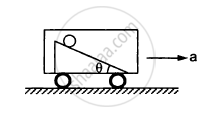
The following figure shows a smooth inclined plane fixed in a car accelerating on a horizontal road. The angle of incline θ is related to the acceleration a of the car as a = g tanθ. If the sphere is set in pure rolling on the incline, _____________.
A solid sphere of mass 0⋅50 kg is kept on a horizontal surface. The coefficient of static friction between the surfaces in contact is 2/7. What maximum force can be applied at the highest point in the horizontal direction so that the sphere does not slip on the surface?
Discuss the interlink between translational, rotational and total kinetic energies of a rigid object rolls without slipping.
A uniform disc of mass 100g has a diameter of 10 cm. Calculate the total energy of the disc when rolling along with a horizontal table with a velocity of 20 cms-1. (take the surface of the table as reference)
A solid sphere rolls down from top of inclined plane, 7m high, without slipping. Its linear speed at the foot of plane is ______. (g = 10 m/s2)
Solid spherical ball is rolling on a frictionless horizontal plane surface about is axis of symmetry. The ratio of rotational kinetic energy of the ball to its total kinetic energy is ______.
A disc of mass 4 kg rolls on a horizontal surface. If its linear speed is 3 m/ s, what is its total kinetic energy?
