Advertisements
Advertisements
प्रश्न
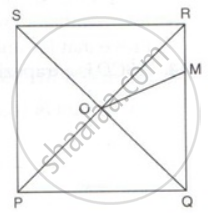
PQRS is a square whose diagonals PR and QS intersect at O.M is a point on QR such that OQ = MQ. Find the measures of ∠MOR and ∠QSR.
Advertisements
उत्तर
In ΔQOM,
∠OQM = 45° ...(In square diagonals make 45° with the sides)
OQ = MQ
⇒ ∠QOM = ∠QMO (i) ...(equal sides have equal angles opposite to them)
∠QOM + ∠QMO + ∠OQM = 180°
∠QOM + ∠QOM + 45° = 180°
2∠QOM = 180° - 45°
∠QOM = 67.5°
In ΔQOR,
∠QOR = 90° ...(diagonals bisect at right angles)
∠QOM + ∠MOR = 90°
67.5° + ∠MOR = 90°
∠MOR = 22.5°
In ΔROS,
∠OSR = 45° ...(In square diagonals make 45° with the sides)
⇒ ∠QSR = 45°.
APPEARS IN
संबंधित प्रश्न
All rectangles are squares
All squares are rhombuses and also rectangles.
All squares are not parallelograms.
Explain how a square is a quadrilateral
Explain how a square is a parallelogram
Explain how a square is a rhombus.
Explain how a square is a rectangle
In the given figure, ΔPQR is right-angled at P. PABQ and QRST are squares on the side PQ and hypotenuse QR. If PN ⊥ TS, show that:
(a) ΔQRB ≅ ΔPQT
(b) Area of square PABQ = area of rectangle QTNM.
In the given figure AF = BF and DCBF is a parallelogram. If the area of ΔABC is 30 square units, find the area of the parallelogram DCBF.
In a parallelogram PQRS, T is any point on the diagonal PR. If the area of ΔPTQ is 18 square units find the area of ΔPTS.
