Advertisements
Advertisements
प्रश्न
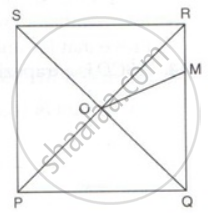
PQRS is a square whose diagonals PR and QS intersect at O.M is a point on QR such that OQ = MQ. Find the measures of ∠MOR and ∠QSR.
Advertisements
उत्तर
In ΔQOM,
∠OQM = 45° ...(In square diagonals make 45° with the sides)
OQ = MQ
⇒ ∠QOM = ∠QMO (i) ...(equal sides have equal angles opposite to them)
∠QOM + ∠QMO + ∠OQM = 180°
∠QOM + ∠QOM + 45° = 180°
2∠QOM = 180° - 45°
∠QOM = 67.5°
In ΔQOR,
∠QOR = 90° ...(diagonals bisect at right angles)
∠QOM + ∠MOR = 90°
67.5° + ∠MOR = 90°
∠MOR = 22.5°
In ΔROS,
∠OSR = 45° ...(In square diagonals make 45° with the sides)
⇒ ∠QSR = 45°.
APPEARS IN
संबंधित प्रश्न
All rectangles are squares
All squares are rhombuses and also rectangles.
All squares are not parallelograms.
Identify all the quadrilaterals that have four right angles
Explain how a square is a parallelogram
Explain how a square is a rectangle
In a quadrilateral ABCD, AB = AD and CB = CD.
Prove that:
- AC bisects angle BAD.
- AC is the perpendicular bisector of BD.
In square PQRS :
(i) if PQ = 3x – 7 and QR = x + 3 ; find PS
(ii) if PR = 5x and QS = 9x – 8. Find QS
In the given figure, ΔPQR is right-angled at P. PABQ and QRST are squares on the side PQ and hypotenuse QR. If PN ⊥ TS, show that:
(a) ΔQRB ≅ ΔPQT
(b) Area of square PABQ = area of rectangle QTNM.
In a parallelogram PQRS, T is any point on the diagonal PR. If the area of ΔPTQ is 18 square units find the area of ΔPTS.
