Advertisements
Advertisements
प्रश्न
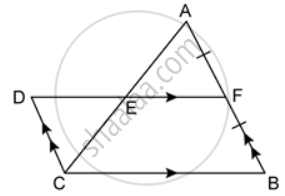
In the given figure AF = BF and DCBF is a parallelogram. If the area of ΔABC is 30 square units, find the area of the parallelogram DCBF.
Advertisements
उत्तर
In ΔABC,
AF = FB and EF || BC ...(given)
∴ AE = EC ...(Converse of Midpoint theorem) ...(i)
In ΔAEF and ΔCED,
∠FEA = ∠DEC ...(Vertically opposite angles)
CE = AE ...[From (i)]
∠FAE = ∠DCE ...(Alternate angles)
∴ ΔFAE ≅ ΔCED ...( ASA test of congruency)
⇒ A(ΔAEF) = A(ΔCED) ....(ii)
A(ΔABC)
= A(ΔAEF) + A(EFBC)
= A(ΔCED) + A(EFBC) ....[From (ii)]
∴ A(ΔABC) = A(||gm DCBF)
⇒ A(||gm DCBF) = 30 sq. units.
APPEARS IN
संबंधित प्रश्न
All squares are rhombuses and also rectangles.
All squares are not parallelograms.
Identify all the quadrilaterals that have four right angles
Explain how a square is a quadrilateral
Explain how a square is a rhombus.
Explain how a square is a rectangle
In a quadrilateral ABCD, AB = AD and CB = CD.
Prove that:
- AC bisects angle BAD.
- AC is the perpendicular bisector of BD.
In square PQRS :
(i) if PQ = 3x – 7 and QR = x + 3 ; find PS
(ii) if PR = 5x and QS = 9x – 8. Find QS
PQRS is a square whose diagonals PR and QS intersect at O.M is a point on QR such that OQ = MQ. Find the measures of ∠MOR and ∠QSR.
Prove that the quadrilateral formed by joining the mid-points of a square is also a square.
