Advertisements
Advertisements
प्रश्न
Obtain the expression for the resonant frequency of the LCR series circuit and explain electrical resonance in an LCR series circuit.
Advertisements
उत्तर
- A circuit in which inductance L, capacitance C, and resistance R are connected in series and the circuit admits maximum current corresponding to a given frequency of AC, is called a series resonance circuit.

- The impedance (Z) of an LCR circuit is given by,
Z = `sqrt("R"^2 + (omega"L" - 1/(omega"C"))^2` - At very low frequencies, inductive reactance XL = ωL is negligible but capacitive reactance XC = `1/(omega"L")` is very high.
- As we increase the applied frequency then XL increases and XC decreases.
- At some angular frequency (ωr), XL = XC
i.e., ωrL = `1/(omega_"r""C")`
∴ `(ω_"r")^2 = 1/"LC" "or" (2pi"f"_"r")^2 = 1/"LC"`
∴ `2pi"f"_"r" = 1/sqrt("LC")`
∴ fr = `1/(2pisqrt"LC")`
Where fr is called the resonant frequency. - At this particular frequency fr, since XL = XC we get Z = `sqrt("R"^2 + 0)` = R.
This is the least value of Z. - Thus, when the impedance of an LCR circuit is minimum, the circuit is said to be purely resistive, current and voltage are in phase, and hence the current `"i"_0 = "e"_0/"Z" = "e"_0/"R"` is maximum. This condition of the LCR circuit is called resonance condition and this frequency is called series resonant frequency.
APPEARS IN
संबंधित प्रश्न
In a series LCR circuit at resonance, the applied emf and current are - ______
A series LCR resonant circuit is used as ______
A parallel LC resonant circuit is used as ______
State any two characteristics of a series LCR AC resonance circuit.
In the LCR series circuit, what are the (a) impedance and (b) reactance at current resonance?
A parallel plate air condenser of capacity 10 µF is charged to a potential of 1000 V. The energy of the condenser is ______
In an LCR circuit, at resonance ______
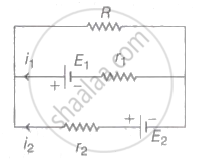
In the given electrical circuit, which one of the following equations is a correct equation?
A transistor-oscillator using a resonant circuit with an inductor L (of negligible resistance) and a capacitor C in series produce oscillation of frequency f. If L is doubled and C is changed to 4C, the frequency will be ____________.
In LCR circuit, the capacitance is changed from C to 4C. For some resonant frequency, the inductance should be changed from L to ____________.
At what frequency (approximate) will the inductive reactance of 4 H inductance be equal to the capacitive reactance of 4 µF capacitance?
In series resonant circuit, at resonance, ____________.
A coil of 16 mH and a capacitor of 10 µF are in series with an A.C source along with 5 `Omega` resistances. If inductive reactance is equal to capacitive reactance, then the angular frequency (in rad/s) of source is ____________.
The resonant frequency of a series LCR circuit is 'f'. The circuit is now connected to the sinusoidally alternating e.m.f of frequency '2f'. The new reactance X'L and X'C are related as ____________.
An a.c. source of variable frequency 'f' is connected to an LCR series circuit. Which one of the graphs represent the variation of current 'I' in the circuit with frequency 'f'?
The LCR series and parallel resonant circuits are respectively called as ____________.
In LC parallel resonance circuit, choose the correct statement.
An electric lamp connected in series with a capacitor and an AC source glows with a certain brightness. (a) How does the average power change on increasing the capacitance? (b) How does the brightness of the lamp change on increasing the capacitance?
What is an acceptor circuit?
A coil of resistance 5 Ω and self inductance 0.2 H is connected in series with variable capacitor across a 30 V(rms), 50 Hz supply. (i) At what capacitance resonance occur? (ii) Find the corresponding current.
In LCR series circuit, the condition for current resonance is ______.
What are the Uses of rejector circuit?
In an L-C-R series resonant circuit, the angular frequency at resonance is ‘ω’. When the inductance of inductance is made twice and capacitance of the capacitor is made four times, the angular frequency at resonance is ‘ω₁’. The ratio of ω: ω₁ is
