Advertisements
Advertisements
प्रश्न
Name the systems that carry out the different functions of the body.
Advertisements
उत्तर
The respiratory, digestive, circulatory, nervous, skeletal, and excretory systems are some of the systems that carry out different functions of the body.
संबंधित प्रश्न
The diagram given below represents a section of the human heart. Answer the questions that follow:
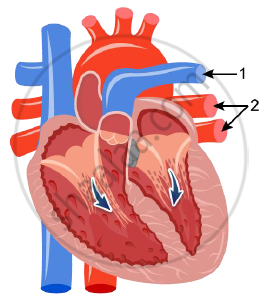
- Which parts of heart are in the diastolic phase? Give a reason to support your answer.
- Label the parts numbered 1 and 2 in the diagram. What type of blood flows through them?
- What causes the heart sounds ‘LUBB’ and ‘DUP’?
- Name the blood vessels that supply oxygenated blood to the heart muscles.
- Draw neat labelled diagrams of a cross section of an artery and a vein.
Give appropriate biological or technical terms for the following
The relaxation phase of the heart.
Given below is a diagram of a human blood smear. Study the diagram and answer the questions that follow:

- Name the components numbered ‘1’ to ‘4’.
- Mention two structural differences between the parts ‘1’ and ‘2’.
- Name the soluble protein found in part ‘4’ which forms insoluble threads during clotting of blood.
- What is the average lifespan of the component numbered ‘1’ ?
- Component numbered ‘1’ do not have certain organelles but are very efficient in their function. Explain.
Given alongside is a diagram of human heart showing its internal structures. Label the parts marked 1 to 6, and answer the following questions.

- Which type of blood is carried by the blood vessel marked 2?
- Name the main artery which takes the blood from heart to different parts of the body?
- Which chamber of the heart receives deoxygenated blood from the body?
MULTIPLE CHOICE TYPE:
(Select the most appropriate option)
The valve present between the right atrium and the right ventricle is the
(a) tricuspid valve
(b) bicuspid valve
(c) semi-lunar valve
(d) mitral valve
Explain with reasons.
Human blood is red coloured.
Why does the left ventricle possess a thicker wall than the right ventricle?
The table below is designed to indicate the transport of certain substances in our body. Fill in the blanks with suitable answers.
| Substance | From | To | |
| 1. | ______ | Lungs | Whole Body |
| 2. | Carbon Dioxide | ______ | ______ |
| 3. | Urea | ______ | ______ |
| 4. | Digested Carbohydrates | Intestines | ______ |
| 5. | ______ | ______ | Target Organs |
| 6. | Heat | ______ | Whole Body |
Given below are four statements regarding human blood circulatory system:-
- Arteries are thick walled and have narrow lumen as compared to veins.
- Angina is acute chest pain when the blood circulation to the brain is reduced.
- Persons with blood group AB can donate blood to any person with any blood group under ABO system.
- Calcium ions play a very important role in blood clotting.
Which two of the above statements are correct?
Ventricles have ______ walls when compared with those of auricles.
