Advertisements
Advertisements
प्रश्न
Name different steps involved in animal nutrition. Explain.
Advertisements
उत्तर
The steps involved in animal nutrition are:
- Ingestion - It means taking solid or liquid food inside the body.
- Digestion - It is the breaking down of complex insoluble food components into simple soluble substances.
- Absorption - It is the process by which soluble soluble digested food passes from alimentary canal into blood and lymph through intestinal villi.
- Assimilation - Utilization of absorbed food by different body cells is called assimilation.
- Egestion - Elimination of undigested food as faeces is called egestion.
APPEARS IN
संबंधित प्रश्न
Digestion of starch starts in the stomach.
What is trypsin?
Name the following:
An enzyme secreted by gastric glands in stomach which acts on proteins.
Study the diagram given below and then answer the question that follows:
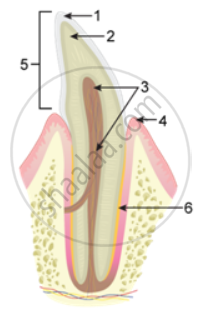
Name the parts labelled 1, 2, 3, 4, 5 and 6.
Write the function of the following in the human alimentary canal:
Villi
Put a tick (✓) against the most appropriate alternative in the following statement.
The hardest substance in your body?
State whether the following statement is True or False.
Wisdom tooth appears at the age of 5-6 years when the child starts going to school.
Name the types of teeth in human with functions.
Mark odd one in the series:
Correct the spellings: Pespin
The question has four options. Choose the correct answer:
Trypsin is connected with the digestion of
The question has four options. Choose the correct answer:
Teeth present in the upper molar of human beings are
Breakdown of food into smaller molecules in our body is known as
The other name of food pipe is alimentary canal.
Secretions of ____________ lubricate the lumen of the alimentary canal.
The contraction and expansion movement of the walls of the food pipe is called ____________.
______ is a major organ for the digestion of food materials.
Digestion of food starts in ______ and gets completed in ______.
