Advertisements
Advertisements
प्रश्न
Match the items of Column I with the items of Column II with reference to sewage.
| Column I | Column II | ||
| (a) | Inorganic impurities | (i) | phosphorus and nitrogen |
| (b) | Organic impurities | (ii) | nitrates and phosphates |
| (c) | Nutrients | (iii) | cholera and typhoid |
| (d) | Bacteria | (iv) | pesticides and herbicides |
Advertisements
उत्तर
| Column I | Column II | ||
| (a) | Inorganic impurities | (ii) | nitrates and phosphates |
| (b) | Organic impurities | (iv) | pesticides and herbicides |
| (c) | Nutrients | (i) | phosphorus and nitrogen |
| (d) | Bacteria | (iii) | cholera and typhoid |
APPEARS IN
संबंधित प्रश्न
The solubility of a gas in water.............. with rise in temperature and.......................with rise in pressure.
.................... is the purest form of natural water.
Give one word for the following statement:
A mixture of common salt and ice .
Identify A, B, C and D; first one is done for you.
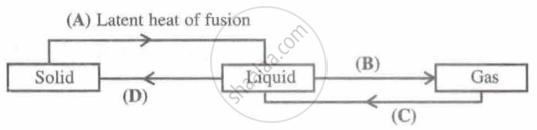
What is the importance of dissolved impurities in water?
What do you understand by permanent hardness?
What will happen if the total supply of potable water is finished?
Give the importance of dissolved minerals & salts.
Give a balanced equation for the following conversion:
Magnesium bicarbonate in temporary hard water to magnesium carbonate by boiling.
Fill in the blank:
The type of water softened by addition of washing soda is ______.
Name one substance which is ‘deliquescent’.
Define ‘eutrophication’.
Match the terms in List I with the correct answers in List II.
| List I | List II |
| 1. Solubility in a given solvent decreases with an increase in temperature. | A: Na2SO4.10H2O |
| 2. A white efflorescent crystal | B: NaOH |
| 3. A hygroscopic dehydrating agent | C: Ca(HCO3)2 |
| 4. A deliquescent alkali | D: conc. H2SO4 |
| 5. A substance present in temporary hard water | E: CaSO4 |
Which are the three states of water?
If, at some place, it did not rain for a very long period of time, what would be its effect on the life of the people there?
_____ is a type of rainwater harvesting.
Match Column I with Column II
| Column I | Column II | ||
| (a) | Ground water | (i) | Solid form of water |
| (b) | Bawri | (ii) | Wastage of water |
| (c) | Snow | (iii) | Water management |
| (d) | Drip irrigation | (iv) | Small water |
| (e) | Leaking taps | (v) | Water table |
Fill in the blanks in the following statements using words given in the box.
| air, handpumps, cholera, water, large, ground |
A very ______ number of our people defecate in the open. It may cause ______ pollution and soil pollution. Both the surface water and ______ water get polluted. ______ water is the source for wells, tubewells and ______. Thus it becomes the most common route for ______ borne diseases like ______, dysentery, etc.
Fill in the blanks selecting words from the following list
snow, rain, clouds, vapour, evaporation, transpiration.
Water, as ______ goes into atmosphere by the processes of ______ and ______ and forms ______, which on condensation fall in the form of ______ and ______.
