Advertisements
Advertisements
प्रश्न
Why should we not throw cooking oil and fats down the drain?
Advertisements
उत्तर
Cooking oil and fats should not be disposed of off down the drains as these get harden and block pipes. They reduce the flow of water and result in stagnant water, which provides a breeding ground for mosquitoes and flies and spreads infectious diseases.
APPEARS IN
संबंधित प्रश्न
Give balanced chemical equation for the reaction of water with Sodium .
Give the molecular formula of water ?
Use of excessive .................... by farmers causes water pollution.
Give one word for the following statement :
The change of states of water from one form to another .
Answer the following question:
What is the chemical composition of water ? Give its molecular formula.
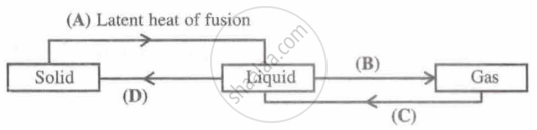
Identify A, B, C and D; first one is done for you.
What is the composition of water? In what volume its elements combine?
Name a ‘pure form’ and an,‘impure form’ of water in the natural state.
Give a reason why alcohol and water form a miscible mixture while oil & water do not.
Select the correct answer of the following statement:
A drying agent placed in desiccator.
Household detergents contain mainly ______ and pollute water bodies.
Name one substance which is ‘deliquescent’.
Select the correct word from the words in option to complete the sentence:
If pressure on the surface of water increases its boiling point ____ and freezing point ____.
Give a reason for the following:
Efflorescence is minimum during humid conditions.
Match the following
| 1. | Flood | Lake |
| 2. | Surface water | Evaporation |
| 3. | Sunlight | Water vapour |
| 4. | Cloud | Pole |
| 5. | Frozen water | Increased rainfall |
State whether the following statement is True or False. If false, write the correct statement.
Rapid growth of industries is one of the causes for water shortage
Water polluted by various human activities causes a number of water borne diseases. Which of the following is not a water borne disease?
Pick from the following one chemical used to disinfect water.
Fill in the blanks selecting words from the following list
snow, rain, clouds, vapour, evaporation, transpiration.
Water, as ______ goes into atmosphere by the processes of ______ and ______ and forms ______, which on condensation fall in the form of ______ and ______.
