Advertisements
Advertisements
प्रश्न
Match the column-I with column-II and re-write the matching pairs.
| Column-I | Column-II |
| 1. 21 trisomy | a. Turner’s syndrome |
| 2. X-monosomy | b. Klinefelter’s syndrome |
| 3. Holandric traits | c. Down's syndrome |
| 4. Feminized male | d. Hypertrichosis |
Advertisements
उत्तर
| Column-I | Column-II |
| 1. 21 trisomy | c. Down's syndrome |
| 2. X-monosomy | a. Turner’s syndrome |
| 3. Holandric traits | d. Hypertrichosis |
| 4. Feminized male | b. Klinefelter’s syndrome |
APPEARS IN
संबंधित प्रश्न
A couple with normal vision bear a colour blind child. Work out a cross to show how it is possible and mention the sex of the affected child.
Answer the following question.
Both Haemophilia and Thalessemia are blood-related disorders in humans. Write their causes and the difference between the two. Name the category of genetic disorder they both come under.
A disease caused by an autosomal primary non-disjunction is ______.
Genes for cytoplasmic male sterility in plants are generally located in ______.
It is well known that Queen Victoria of England was a carrier for haemophilia. Since this is an X-linked disease, it can be predicted that ______.
Mongolism is a genetic disorder which is caused by the presence of an extra chromosome number ______.
Jacob is genetically a carrier of the disorder that affects the shape of the RBCs, as shown in the diagram below. His son James suffers from the same disorder.
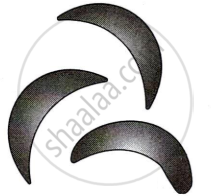
- Give the biochemical reason for the disorder that changes the shape of the RBCs, as shown above.
- Draw a Punnett square to show the genotype of the mother of James.
- Name and define the type of 'point mutation' responsible for this disorder.
Match the disorder in column I with their nature in column II.
| Column I | Column II | ||
| i. | Thalassemia | a. | X monosomy |
| ii. | Turner’s syndrome | b. | Extra X chromosomes in male |
| iii. | Klinefelter’s syndrome | c. | 21st Trisomy |
| iv. | Down’s syndrome | d. | Mendelian disorder |
Which of the following correctly represents the chain of causation from gene defect to disease phenotype?
How many pairs of autosomes are present in the human karyotype?
