Advertisements
Advertisements
प्रश्न
Name the disorder caused by under secretion of thyroxine in children
Advertisements
उत्तर
Hyposecretion of thyroxine in children causes cretinism
APPEARS IN
संबंधित प्रश्न
Give any 'two' names of X-linked diseases
Webbed neck is characteristic of ______ syndrome.
Write a note on Down’s syndrome.
Feminised males have ______ chromosomes.
Identify I and II in the given diagram of chromosome.
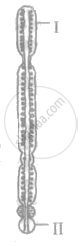
Mental retardation in man associated with sex chromosomal abnormality is usually due to ______.
Select the incorrect statement regarding pedigree analysis.
Failure of segregation of chromatids during cell division results in the gain or loss of chromosomes, this is called as ______.
Read the following and answer from given below:
Turner's syndrome is an example of monosomy. It is formed by the union of an allosome-free egg and a normal 'X' containing sperm or a normal egg and an allosome-free sperm. The individual has 2n = 45 chromosomes (44 + X0) instead of 46. Such individuals are sterile females who have rudimentary ovaries, underdeveloped breasts, small uterus, short stature, webbed neck, and abnormal intelligence. They may not menstruate or ovulate. This disorder can be treated by giving female sex hormones to women from the age of puberty to make them develop breasts and have menstruation. This makes them feel more normal.
Turner's syndrome is a/an ______
Which of the folowing is a correct match?
