Advertisements
Advertisements
प्रश्न
Justify your answer.
| Figure 1 | Figure 2 | Figure 3 |
![]() |
![]() |
![]() |
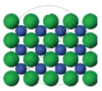
The arrangement of particles in three different phases of matter is shown above.
- Which state is represented by Fig. 1?
- In which state will the inter-particle attraction be maximum?
- Which one of them cannot be contained in an open vessel?
- Which one can take the shape of its container?
Advertisements
उत्तर
- The liquid state is represented by Fig 1.
- In Fig. 3 the inter-particle attraction will be maximum because it is in a solid state.
- Fig. 2 cannot be contained in an open vessel, as it is in a gaseous state.
- Fig. 1 can take the shape of its container, as it is in a liquid state.
APPEARS IN
संबंधित प्रश्न
Name two solid, two liquid and two gaseous elements at the room temperature.
Name a metal which forms amalgams.
There is a large group of materials P which can be divided into three groups Q, R and S on the basis of their properties. The substances belonging to group Q can be solids, liquids or gases. The solids belonging to group Q are usually electrical insulators. Most of the substances of group R are solids which are good conductors of electricity. The substances belonging to group S are neither insulators like Q nor good conductors like R. The properties of S are intermediate between those of Q and R.
- What could the group of materials P be ?
- Name the substances Q. Give two examples of such substances.
- Name the substances R. Write two examples of such substances.
- Name the substances S. Give two examples of such substances.
- Out of Q, R and S, which substances are malleable and ductile ?
A, B and C are all liquids. Liquid A has a comparatively low boiling point. On heating, liquid A vaporises completely without leaving behind any residue. Liquid A is being used increasingly as a fuel in motor vehicles either alone or by mixing with petrol. Liquid B has a very high boiling point. It also vaporises completely on heating, without leaving any residue. Liquid B is a conductor of electricity and used in making thermometers. Liquid C has a moderate boiling point. On heating, liquid C vaporises leaving behind a white solid D which is used in cooking vegetables. The condensation of vapours from C give a liquid E which turns anhydrous CuSO4 to blue.
(a) Which liquid could be an element ? Name this element.
(b) Which liquid could be a mixture ? Name this mixture.
(c) Which liquid could be a compound ? Name this compound.
(d) What could the solid D be ?
(e) What do you think is liquid E ?
In what respects does a true solution differ from a colloidal solution ?
21.5 g of sodium chloride dissolves in 60 g of water at 25°C. Calculate the solubility of sodium chloride in water at that temperature.
How is scrap iron separated from a heap of waste materials in factories?
Draw a labelled diagram of the fractional distillation apparatus used for separating a mixture of alcohol and water.
The non S I and S I units of some physical quantities are given in column A and column B respectively. Match the units belonging to the same physical quantity:
| (A) | (B) | ||
| (a) | degree celsius | (i) | kilogram |
| (b) | centimetre | (ii) | pascal |
| (c) | gram per centimetre cube | (iii) | metre |
| (d) | bar | (iv) | kelvin |
| (e) | milligram | (v) | kilogram per metre cube |
Examples of foam are ______.