Advertisements
Advertisements
प्रश्न
In young’s double slit experiment, deduce the conditions for obtaining constructive and destructive interference fringes. Hence, deduce the expression for the fringe width.
Advertisements
उत्तर
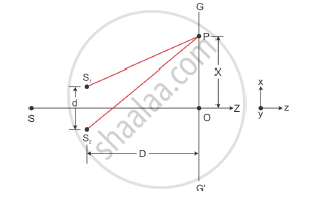
Young’s double slit experiment demonstrated the phenomenon of interference of light. Consider two fine slits S1 and S2 at a small distance d apart. Let the slits be illuminated by a monochromatic source of light of wavelength λ. Let GG′ be a screen kept at a distance D from the slits. The two waves emanating from slits S1 and S2 superimpose on each other resulting in the formation of an interference pattern on the screen placed parallel to the slits.
Let O be the centre of the distance between the slits. The intensity of light at a point on the screen will depend on the path difference between the two waves reaching that point. Consider an arbitrary point P at a distance x from O on the screen.
Path difference between two waves at P = S2P − S1P
The intensity at the point P is maximum or minimum as the path difference is an integral multiple of wavelength or an odd integral multiple of half wavelength
For the point P to correspond to maxima, we must have
S2P − S1P = n, n = 0, 1, 2, 3...
From the figure given above
`(S_2P)^2-(S_1P)^2=D^2+(x+d/2)^2-D^2+(x-d/2)^2`
On solving we get:
(S2P)2-(S1P)2=2xd
`S_2P-S_1P=(2xd)/(S_2P+S_1P)`
As d<<D, then S2P + S2P = 2D (∵ S1P = S2P ≡ D when d<<D)
`:.S_2P-S_1P=(2xd)/(2D)=(xd)/D`
Path difference, `S_2P-S_1P=(xd)/D`
Hence, when constructive interfernce occur, bright region is formed.
For maxima or bright fringe, path difference = `xd/D=nlambda`
i.e `x=(nlambdaD)/d`
where n=0,± 1, ±2,........
During destructive interference, dark fringes are formed:
Path difference, `(xd)/D=(n+1/2)lambda`
`x=(n+1/2)(lambdaD)/d`
The dark fringe and the bright fringe are equally spaced and the distance between consecutive bright and dark fringe is given by:
β = xn+1-xn
`beta=((n+1)lambdaD)/d-(nlambdaD)/d`
`beta=(lambdaD)/d`
Hence the fringe width is given by `beta = (lambdaD)/d`
APPEARS IN
संबंधित प्रश्न
How does the fringe width get affected, if the entire experimental apparatus of Young is immersed in water?
In Young’s experiment interference bands were produced on a screen placed at 150 cm from two slits, 0.15 mm apart and illuminated by the light of wavelength 6500 Å. Calculate the fringe width.
In Young's double slit experiment using monochromatic light of wavelength 600 nm, 5th bright fringe is at a distance of 0·48 mm from the centre of the pattern. If the screen is at a distance of 80 cm from the plane of the two slits, calculate:
(i) Distance between the two slits.
(ii) Fringe width, i.e. fringe separation.
In Young’s double slit experiment, what is the effect on fringe pattern if the slits are brought closer to each other?
How will the interference pattern in Young's double-slit experiment be affected if the phase difference between the light waves emanating from the two slits S1 and S2 changes from 0 to π and remains constant?
A fringe width of 6 mm was produced for two slits separated by 1 mm apart. The screen is placed 10 m away. The wavelength of light used is 'x' nm. The value of 'x' to the nearest integer is ______.
What is the consequence of random phase variation for ordinary light sources?
What is the interference pattern observed on the screen in Young's double-slit experiment?
What is the angular fringe width \(\alpha\)?
What happens to fringe width when slit separation increases while wavelength and screen distance remain unchanged?
