Advertisements
Advertisements
प्रश्न
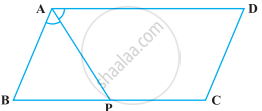
In the following figure, P is the mid-point of side BC of a parallelogram ABCD such that ∠BAP = ∠DAP. Prove that AD = 2CD.
Advertisements
उत्तर
Given in the question, in a parallelogram ABCD, P is a mid-point of BC such that ∠BAP = ∠DAP.
To prove that AD = 2CD
Proof: ABCD is a parallelogram
So, AD || BC and AB is transversal, then
∠A + ∠B = 180° ...[Sum of cointerior angles is 180°]
∠B = 180° – ∠A ...(i)
Now, in triangle ABP,
∠PAB + ∠B + ∠BPA = 180° ...[By angle sum property of a triangle]
`1/2 ∠A + 180^circ - ∠A + ∠BPA = 180^circ` ...[From equation (i)]
`∠BPA - (∠A)/2 = 0`
`∠BPA = (∠A)/2` ...(ii)
∠BPA = ∠BAP
AB = BP ...[Opposite sides of equal angles are equal]
In above equation multiplying both side by 2, we get
2AB = 2BP
2AB = BC ...[P is the mid-point of BC]
2CD = AD ...[ABCD is a parallelogram, then AB = CD and BC = AD]
APPEARS IN
संबंधित प्रश्न
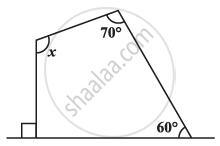
Find the angle measure x in the given Figure
Two opposite angles of a parallelogram are (3x – 2)° and (50 – x)°. Find the measure of each angle of the parallelogram .
If an angle of a parallelogram is two-third of its adjacent angle, find the angles of the parallelogram .
If the degree measures of the angles of quadrilateral are 4x, 7x, 9x and 10x, what is the sum of the measures of the smallest angle and largest angle?
Can all the four angles of a quadrilateral be obtuse angles? Give reason for your answer.
One angle of a quadrilateral is of 108º and the remaining three angles are equal. Find each of the three equal angles.
If three angles of a quadrilateral are each equal to 75°, the fourth angle is ______.
The sum of all ______ of a quadrilateral is 360°.
The polygon in which sum of all exterior angles is equal to the sum of interior angles is called ______.
In a quadrilateral PQRS, ∠P = 50°, ∠Q = 50°, ∠R = 60°. Find ∠S. Is this quadrilateral convex or concave?
