Advertisements
Advertisements
प्रश्न
In the following figure, ABCD and AEFD are two parallelograms. Prove that ar (PEA) = ar (QFD). [Hint: Join PD].

Advertisements
उत्तर
Given: ABCD and AEFD are two parallelograms.
To prove: ar (APEA) = ar (AQFD)
Proof: In quadrilateral PQDA,
AP || DQ ...[Since, in parallelogram ABCD, AB || CD]
And PQ || AD ...[Since, in parallelogram AEFD, FE || AD]
Then, quadrilateral PQDA is a parallelogram.
Also, parallelogram PQDA and AEFD are on the same base AD and between the same parallels AD and EQ.
ar (parallelogram PQDA) = ar (parallelogram AEFD)
On subtracting ar (quadrilateral APFD) from both sides, we get
ar (parallelogram PQDA) – ar (quadrilateral APFD)
= ar (parallelogram AEFD) – ar (quadrilateral APFD)
⇒ ar (AQFD) = ar (APEA)
Hence proved.
APPEARS IN
संबंधित प्रश्न
P and Q are any two points lying on the sides DC and AD respectively of a parallelogram ABCD. Show that ar (APB) = ar (BQC).
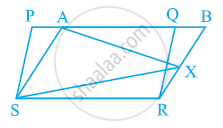
In the given figure, PQRS and ABRS are parallelograms and X is any point on side BR. Show that
(i) ar (PQRS) = ar (ABRS)
(ii) ar (AXS) = 1/2ar (PQRS)
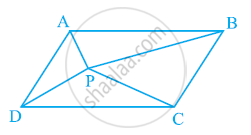
In the given figure, P is a point in the interior of a parallelogram ABCD. Show that
(i) ar (APB) + ar (PCD) = 1/2ar (ABCD)
(ii) ar (APD) + ar (PBC) = ar (APB) + ar (PCD)
[Hint: Through. P, draw a line parallel to AB]
Parallelogram ABCD and rectangle ABEF are on the same base AB and have equal areas. Show that the perimeter of the parallelogram is greater than that of the rectangle.
In the following figure, ABCD, DCFE and ABFE are parallelograms. Show that ar (ADE) = ar (BCF).

In the following figure, ABCD is parallelogram and BC is produced to a point Q such that AD = CQ. If AQ intersect DC at P, show that
ar (BPC) = ar (DPQ).
[Hint: Join AC.]

In which of the following figures, you find two polygons on the same base and between the same parallels?
ABCD is a square. E and F are respectively the mid-points of BC and CD. If R is the mid-point of EF (Figure), prove that ar (AER) = ar (AFR)

The diagonals of a parallelogram ABCD intersect at a point O. Through O, a line is drawn to intersect AD at P and BC at Q. Show that PQ divides the parallelogram into two parts of equal area.
ABCD is a trapezium in which AB || DC, DC = 30 cm and AB = 50 cm. If X and Y are, respectively the mid-points of AD and BC, prove that ar (DCYX) = `7/9` ar (XYBA)
