Advertisements
Advertisements
प्रश्न
In ∆PQR, PQ = √8 , QR = √5 , PR = √3. Is ∆PQR a right-angled triangle? If yes, which angle is of 90°?
बेरीज
Advertisements
उत्तर
In ∆PQR, PQ = √8 , QR = √5 , PR = √3
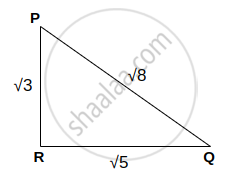
Longest side of ∆PQR = PQ = √8
∴ PQ2 = (√8)2 = 8
Now, the sum of the squares of the remaining sides is
QR2 + PR2 = (√5)2 + (√3)2 = 5 + 3 = 8
∴ PQ2 = QR2 + PR2
∴ The square of the longest side is equal to the sum of the squares of the remaining two sides.
by Converse of Pythagoras theorem,
∴ ∆PQR is a right-angled triangle.
Now, PQ is the hypotenuse.
∴ ∠PRQ = 90° ...(Angle opposite to hypotenuse)
∴ ∆PQR is a right-angled triangle in which ∠PRQ is 90°.
shaalaa.com
या प्रश्नात किंवा उत्तरात काही त्रुटी आहे का?
