Advertisements
Advertisements
प्रश्न
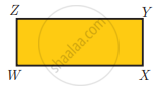
In the rectangle WXYZ, XY + YZ = 17 cm, and XZ + YW = 26 cm. Calculate the length and breadth of the rectangle?
Advertisements
उत्तर
Let the length of the rectangle be “a” and the breadth of the rectangle be “b”.
XY + YZ = 17 cm
b + a = 17 ...(1)
In the right ∆WXZ,
XZ2 = WX2 + WZ2
(XZ)2 = a2 + b2
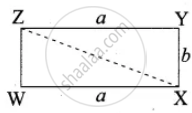
XZ = `sqrt("a"^2 + "b"^2)`
Similarly WY = `sqrt("a"^2 + "b"^2)`
⇒ XZ + WY = 26
⇒ `2sqrt("a"^2 + "b"^2)` = 26
⇒ `sqrt("a"^2 + "b"^2)` = 13
Squaring on both sides
a2 + b2 = 169
(a + b)2 – 2ab = 169
172 – 2ab = 169
⇒ 289 – 169 = 2ab
⇒ 120 = 2ab
⇒ ab = 60
a = `60/"b"` ...(2)
Substituting the value of a = `60/"b"` in (1)
`60/"b" +"b"` = 17
b2 – 17b + 60 = 0
(b – 2) (b – 5) = 0
b = 12 or b = 5

If b = 12
⇒ a = 5
If b = 6
⇒ a = 12
Length = 12 m and breadth = 5 m
APPEARS IN
संबंधित प्रश्न
The hypotenuse of a right triangle is 6 m more than twice of the shortest side. If the third side is 2 m less than the hypotenuse, find the sides of the triangle
If the sides of a triangle are in the ratio 5 : 12 : 13 then, it is ________
8, 15, 17 is a Pythagorean triplet
Check whether given sides are the sides of right-angled triangles, using Pythagoras theorem
8, 15, 17
Check whether given sides are the sides of right-angled triangles, using Pythagoras theorem
24, 45, 51
The area of a rectangle of length 21 cm and diagonal 29 cm is __________
If a triangle having sides 8 cm, 15 cm and 17 cm, then state whether given triangle is right angled triangle or not
A rectangle having dimensions 35 m × 12 m, then what is the length of its diagonal?
In ∆LMN, l = 5, m = 13, n = 12 then complete the activity to show that whether the given triangle is right angled triangle or not.
*(l, m, n are opposite sides of ∠L, ∠M, ∠N respectively)
Activity: In ∆LMN, l = 5, m = 13, n = `square`
∴ l2 = `square`, m2 = 169, n2 = 144.
∴ l2 + n2 = 25 + 144 = `square`
∴ `square` + l2 = m2
∴By Converse of Pythagoras theorem, ∆LMN is right angled triangle.
In the given figure, triangle PQR is right-angled at Q. S is the mid-point of side QR. Prove that QR2 = 4(PS2 – PQ2).

