Advertisements
Advertisements
प्रश्न
In a ∆ABC, AD is the bisector of ∠BAC. If AB = 8 cm, BD = 6 cm and DC = 3 cm. The length of the side AC is
पर्याय
6 cm
4 cm
3 cm
8 cm
Advertisements
उत्तर
4 cm
Explanation;
Hint: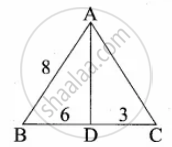
Since AD is the bisector of ∠A
`"BD"/"DC" = "AB"/"AC"`
`6/3 = 8/"AC"`
AC = `(3 xx 8)/6`
= 4 cm
APPEARS IN
संबंधित प्रश्न
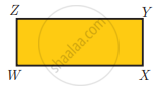
In the rectangle WXYZ, XY + YZ = 17 cm, and XZ + YW = 26 cm. Calculate the length and breadth of the rectangle?
If the sides of a triangle are in the ratio 5 : 12 : 13 then, it is ________
Check whether given sides are the sides of right-angled triangles, using Pythagoras theorem
12, 13, 15
The area of a rectangle of length 21 cm and diagonal 29 cm is __________
In right angled triangle, if sum of the squares of the sides of right angle is 169, then what is the length of the hypotenuse?
If the length of diagonal of square is `sqrt(2)`, then what is the length of each side?
In ∆ABC, AB = `6sqrt(3)` cm, AC = 12 cm, and BC = 6 cm then m∠A = ?
If a triangle having sides 50 cm, 14 cm and 48 cm, then state whether given triangle is right angled triangle or not.
In ∆LMN, l = 5, m = 13, n = 12 then complete the activity to show that whether the given triangle is right angled triangle or not.
*(l, m, n are opposite sides of ∠L, ∠M, ∠N respectively)
Activity: In ∆LMN, l = 5, m = 13, n = `square`
∴ l2 = `square`, m2 = 169, n2 = 144.
∴ l2 + n2 = 25 + 144 = `square`
∴ `square` + l2 = m2
∴ By Converse of Pythagoras theorem, ∆LMN is right angled triangle.
In the given figure, triangle PQR is right-angled at Q. S is the mid-point of side QR. Prove that QR2 = 4(PS2 – PQ2).

