Advertisements
Advertisements
प्रश्न
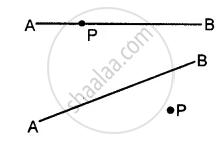
In each of the following, draw perpendicular through point P to the line segment AB :
(i)

(ii)

(iii)
Advertisements
उत्तर
(i) Steps of Construction :
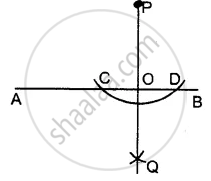
- With P as a centre, draw an arc of a suitable radius which cuts AB at points C and D.
- With C and D as centres, draw arcs of equal radii and let these arcs intersect each other at point Q.
[The radius of these arcs must be more than half of CD and both the arcs must be drawn on the other side] - Join P and Q
- Let PQ cut AB at the point O.
Thus, OP is the required perpendicular clearly, ∠AOP = ∠BOP = 90°
(ii) Steps of Construction :
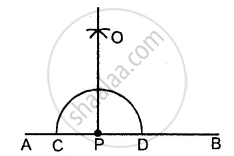
- With P as a centre, draw an arc of any suitable radius which cuts AB at points C and D.
- With C and D as centres, draw arcs of equal radii. Which intersect each other at point A.
[This radius must be more than half of CD and let these arc intersect each other at the point 0] - Join P and O. Then OP is the required perpendicular.
∠OPA = ∠OPB = 90°
(iii) Steps of Construction :
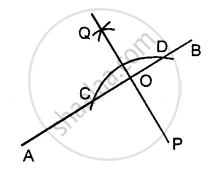
- With P as a centre, draw an arc of any suitable radius which cuts AB at points C and D.
- With C and D as a centre, draw arcs of equal radii
[The radius of these arcs must be more than half of CD and both the arcs must be drawn on the other side.]
and let these arcs intersect each other at the point Q. - Join Q and P. Let QP cut AB at the point O. Then OP is the required perpendicular.
Clearly, ∠AOP = ∠BOP = 90°
APPEARS IN
संबंधित प्रश्न
Draw a line segment AB = 6.2 cm. Mark a point P in AB such that BP = 4 cm. Through point P draw perpendicular to AB.
It is possible to draw two bisectors of a given angle.
Draw a line segment of length 6.5 cm and divide it into four equal parts, using ruler and compasses.
Draw a line segment of length 6 cm. Construct its perpendicular bisector. Measure the two parts of the line segment.
Draw a line segment of length 10 cm. Divide it into four equal parts. Measure each of these parts.
Draw `overline"AB"` of length 7.3 cm and find its axis of symmetry.
Draw a circle with centre C and radius 3.4 cm. Draw any chord `overline"AB"`. Construct the perpendicular bisector of `overline"AB"` and examine if it passes through C.
Draw a circle of radius 4 cm. Draw any two of its chords. Construct the perpendicular bisectors of these chords. Where do they meet?
Which two conditions, when combined, define the Perpendicular Bisector of a line segment AB?
If a line passes through the midpoint of segment AB but does not form a 90° angle, it is:
