Advertisements
Advertisements
प्रश्न
- In a quark model of elementary particles, a neutron is made of one up quarks [charge (2/3) e] and two down quarks [charges –(1/3) e]. Assume that they have a triangle configuration with side length of the order of 10–15 m. Calculate electrostatic potential energy of neutron and compare it with its mass 939 MeV.
- Repeat above exercise for a proton which is made of two up and one down quark.
Advertisements
उत्तर
This system is made up of three charges. The potential energy of the system is equal to the algebraic sum of the PE of each pair. So,
a. `q_d = 1/3 e` charge on down quark
`q_u = + 2/3 e` charge on up quark
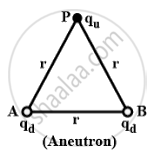
Potential energy U = `(kq_1q_2)/r`
`k = 1/(4piε_0)`
U = `(kq_1q_2)/r + (kq_1q_3)/r + (kq_2q_3)/r`
∴ Un = `1/(4piε_0) ((-q_d)(-q_d))/r + ((-q_d)q_u)/(4piε_0) + (q_u (-q_d))/(4piε_0r)`
= `(q_d)/(4piε_0r) [+q_d - q_u - q_u]` Talking sign of charge
= `(q_d)/(4piε_0r) [q_d - 2q_u]`
= `(9 xx 10^9 xx 1/3 e)/(10^-15) [1/3 e - 2 * 2/3 e]` nature sign of charge taken already
= `(9 xx 10^9 xx e)/(3 xx 10^-15) * e/3 [1 - 4]` Joule
= `(-3 xx 9 xx 10^9 xx 1.6 xx 10^-19)/(9 xx 10^-15)` e Joule
= `- 4.8 xx 10^(9 - 19 - 15) eV`
= `4.8 xx 10^5 eV`
= `- 0.4.8 xx 10^6 eV`
U = – 0.48 MeV
So, charges inside neutron [1qu and 2qd] are attracted by energy of 0.48 MeV.
Energy released by a neutron when converted into energy is 939 MeV.
∴ Required ratio = `(1 - 0.481 MeV)/(939 MeV)` = 0.0005111 = 5.11 × 10⁻⁴
b. P.E. of proton consists of 2 up and 1 down quark

r = 10–15 m
qd = `- 1/3 e, q_u = 2/3 e`
Up = `1/(4 piε_0) (q_u xx q_u)/r + (q_u (-q_d))/(4 piε_0r) + (q_u (-q_d))/(4 piε_0r)`
= `q/(4 piε_0r) [q_u - q_d - q_d]`
= `q/(4 piε_0r) [q_u - 2q_d]`
= `(9 xx 10^9)/10^-13 2/3 e [2/3 e - 2 1/3 e]` = 0
APPEARS IN
संबंधित प्रश्न
Four point charges Q, q, Q and q are placed at the corners of a square of side 'a' as shown in the figure.
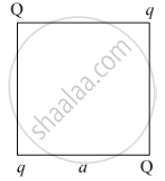
Find the
1) resultant electric force on a charge Q, and
2) potential energy of this system.
Find out the amount of the work done to separate the charges at infinite distance.
A point charge Q is placed at point 'O' as shown in the figure. Is the potential at point A, i.e. VA, greater, smaller or equal to potential, VB, at point B, when Q is (i) positive, and (ii) negative charge?
If a charge q0 is there in an electric field caused by several point charges qi. The potential energy of q0 is given by ________.
1 volt is equivalent to ______.
Consider a uniform electric field in the z-direction. The potential is a constant ______.
- Assertion (A): An electron has a high potential energy when it is at a location associated with a more negative value of potential, and a low potential energy when at a location associated with a more positive potential.
- Reason (R): Electrons move from a region of higher potential to region of lower potential.
Select the most appropriate answer from the options given below:
The electrostatic potential energy of a system of charges is defined as:
If a system of like charges, assembled by doing work against their repulsive force, is released, the stored electrostatic potential energy:
The work done in bringing charge \[q_2\] from infinity to Position 2, in the electric potential \[V_1\] produced by the fixed charge \[q_1\] at separation \[r_{12}\], is:
For a system of n charges, the total number of unique charge pairs whose potential energies must be summed is:
For n charges \[q_1, q_2, \ldots, q_n\] at positions \[r_1, r_2, \ldots, r_n\], where \[r_{ij}\] is the distance between charge i and charge j, the total electrostatic potential energy of the system is:
For two like charges (both positive or both negative), the sign of \[(q_1 q_2)\] and the resulting sign of the potential energy U are:
Four charges +q, -q, +q, -q are arranged alternately at corners A, B, C, D of a square of side d. With +q already at A, the work done in bringing -q from infinity to corner B is:
For the symmetrical arrangement of charges +q, -q, +q, -q at the corners of a square, the electric potential at the centre E due to the four charges is:
