Advertisements
Advertisements
प्रश्न
Imagine that a cow, a horse, a duck and a chicken are meeting for a morning meal. What would they say to one another? Talk about it.
Advertisements
उत्तर
| Cow | Hello Horse! How are you? Aren’t you feeling hungry yet? |
| Horse | Hi Cow! No, I am not feeling well. I had barley and grains already. |
| Duck | I am feeling hungry. I have cooked a small fish for my breakfast. |
| Chicken | Ehh! I don’t like eating fish. It is so boring. Duckie! Can you please cook a fresh grasshopper for me |
| Duck | Sure |
APPEARS IN
संबंधित प्रश्न
Listen to the passage on 'anger management' and match the sentence parts by drawing a line. The recording can be played more than once if needed.
| 1. | Meditation is definitely a great technique ______. | a) who will take care of the reason why you got angry? |
| 2. | There is a person living inside you ______. | b) to know how to handle it is a virtue. |
| 3. | Getting angry is natural but ______. | c) to calm your inner self. |
| 4. | Anger is something that releases the tension ______. | d) speak to your self and calm yourself. |
| 5. | Close your eyes and ______. | e) who always tells you how to act. |
Listen to the paragraph and fill in the blanks.
The ______________South Indian floods resulted from heavy rainfall generated by the annual north east monsoon in _________________ 2015. They affected the ___________ region of the South Indian states of _________________, and the Union Territory of ___________, with Tamil Nadu and the city of __________________ particularly hard-hit. More than ________ people were killed and over 18 lakh people were______________. With estimates of damages and losses ranging from nearly 200 billion rupees to over 1 trillion rupees, the ___________ were the costliest to have occurred in 2015, and were among the costliest natural disasters of the year. The flooding has been attributed to the 2014-16 ________________ .
Listen to the passage about Nammazhwar, an environmental crusader from Tamil Nadu. As you listen, answer the following question. The listening act can be repeated if required.
Pick out ideas from the passage to show that he learnt first and then shared with farmers.
Don’t let ______ on the road ______.
______ into your irctc account.
Your personal details like __________ and __________ are a must.
Listen to the passage carefully and write the answer.
Fleming’s thought at breakfast
Sir Alexander Fleming, who discovered penicillin, was once forced into an interview in New York by two journalists just as he was about to have breakfast. One of them asked him, ‘Sir, what are you thinking about right now? We wish to know what a great scientist think while getting ready for breakfast’. Fleming mused a while on the question and he replied, ‘I am thinking of something very special. The journalist, who were all ears, drew themselves forward. ‘I am thinking, whether to have one egg or two.
- Name the scientist.
- What did he discover?
- Who approached the scientist?
- What was the question asked by the journalist?
- When did they meet the scientist?
Dad used to go fishing with his father.
The daughter also loves to fish.
In the beginning, the Nobel Committee ignored the great advances in theoretical physics because.
Red chilli is also called______.
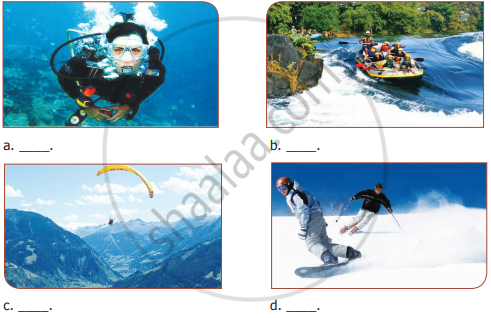
Himachal Pradesh is an ideal place for paragliding.
Centuries ago Udagamandalam was called______.
Listen to the advertisement and answer the question given.
How many accounts can a parent open at the most?
- 3
- 2
- 3
Listen to the audio and respond to the following question.
The weather is sunny in ______.
Listen to the songs of birds. Say the words boy and bee. Listen to the b sound in -
| big | bubbles | bin | bag | blue | blow | black |
Say the words aloud one by one. Follow the instructions and move your body accordingly.
| Shoulders | Move them up and down. |
| Feet | Walk forward and backward. |
| Run | Fast and slow. |
| Hands | Move them left and right. |
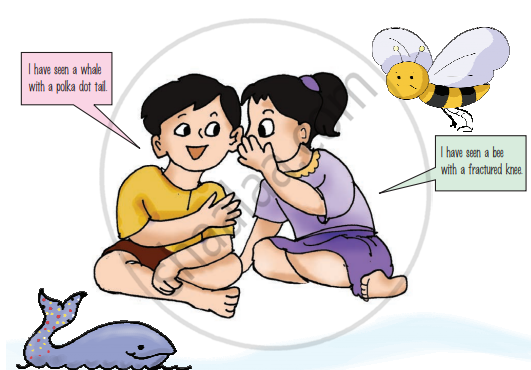
Form a circle and whisper a secret into the ear of the person on your right. He in turn whispers into the ear of the person on the right. Pass the secret on till it goes around the circle. The last person will tell the secret aloud. Is the secret the same as what the first child had whispered?

Also find out how people sent messages in olden days and how they send them nowadays.
Listen to the passage read out aloud by the teacher or played on a recorder and answer the questions that follow.
Listen to the views of a leading economist R. Azhagarasan about EMI in an interview.
We live in a world where everyone likes to lead a comfortable and luxurious life, though our salaries are not enough to meet our needs. In such a situation, the EMI seems to be the only option. It helps people pay for the expensive things, they have purchased, in parts as installments. It gives monetary power to buy expensive things beyond the capacity of a common man. Otherwise, many people will never be able to buy such things. This proves beneficial for people in purchasing a house and other essential appliances and accessories.
It also has some negative unavoidable results. If people are not able to pay EMI on time, they have to keep on paying the loan amount for years together with interest. If people are not able to pay EMI on time, they may face serious problems such as the penalty for default, repossession of the purchased items, and might even be subjected to legal actions. Moreover, people may have the tendency to buy things that are not at all necessary, paying EMIs over a longer period of time. This may lead them into never ending debts. Hence, people should learn to spend within their means.
i. The speaker says that our income is sufficient to meet our needs. Is it true or false?
ii. EMI is the only ______for people who buy very expensive things.
- consolation
- setback
- option
- debt
iii. One is able to buy costly things with ______power offered by EMI.
- physical
- withstanding
- honorary
- monetary
iv. If people fail to pay EMIs, they may be subjected to ______.
- expulsion
- high pressure
- legal action
- dejection
v. People should learn to spend ______their means.
- within
- beyond
- above
- beneath