Advertisements
Advertisements
प्रश्न
If the distance between two Cl atoms in a Cl2 molecule is 1.98Å, then the radius of the Cl atom is ______.
Advertisements
उत्तर
If the distance between two Cl atoms in a Cl2 molecule is 1.98Å, then the radius of the Cl atom is 0.99 Å.
APPEARS IN
संबंधित प्रश्न
State whether the following statement is true of false:
The elements in a group have consecutive atomic numbers.
An element A has an atomic number of 6. Another element B has 17 electrons in its one neutral atom.
(a) In which groups of the periodic table would you expect to find these elements?
(b) what type of bond is formed between A and B?
(c) Suggest a formula of the compound formed between A and B.
A non-metal X which is the largest constituent of air combines with hydrogen when heated in the presence of iron as catalyst to form a gas Y. When gas Y is treated with sulphuric acid, it forms a compound Z which is used as a chemical fertiliser.
(a) What are X, Y and Z?
(b) To which group of periodic table does X belong?
(c) Name the periodic table in which X is placed.
(d) Which element is placed just before X in the period?
(e) Which element is placed just after X in the period?
Which of the following have inert gases 2 electrons in the outermost shell.
Identify the bond between H and F in the HF molecules.
What type of oxide would Eka– aluminium form?
Complete the following cross word puzzle
Across:
(1) An element with atomic number 12.
(3) Metal used in making cans and member of Group 14.
(4) A lustrous non-metal which has 7 electrons in its outermost shell.
Down:
(2) Highly reactive and soft metal which imparts yellow colour when subjected to flame and is kept in kerosene.
(5) The first element of second Period
(6) An element which is used in making fluorescent bulbs and is second member of Group 18 in the Modern Periodic Table
(7) A radioactive element which is the last member of halogen family.
(8) Metal which is an important constituent of steel and forms rust when exposed to moist air.
(9) The first metalloid in Modern Periodic Table whose fibres are used in making bullet-proof vests
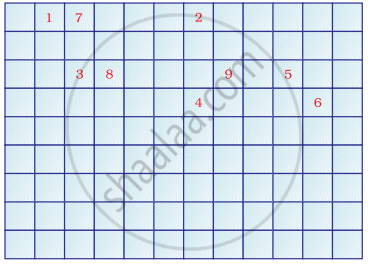
An element X of group 15 exists as diatomic molecule and combines with hydrogen at 773 K in presence of the catalyst to form a compound, ammonia which has a characteristic pungent smell.
- Identify the element X. How many valence electrons does it have?
- Draw the electron dot structure of the diatomic molecule of X. What type of bond is formed in it?
- Draw the electron dot structure for ammonia and what type of bond is formed in it?
Which of the following metals have low melting and boiling point?
Relate the names of the following scientists with the statements given below.
Arranged elements into groups containing three elements each.
