Advertisements
Advertisements
प्रश्न
If P(–1, 1), Q(3, –4), R(1, –1), S(–2, –3) and T(–4, 4) are plotted on the graph paper, then the point(s) in the fourth quadrant are ______.
पर्याय
P and T
Q and R
Only S
P and R
Advertisements
उत्तर
If P(–1, 1), Q(3, –4), R(1, –1), S(–2, –3) and T(–4, 4) are plotted on the graph paper, then the point(s) in the fourth quadrant are Q and R.
Explanation:
In point P(–1, 1), x-coordinate is –1 unit and y-coordinate is 1 unit, so it lies in IInd quadrant.
Similarly, we can plot all the points Q(3, –4), R(1, –1), S(–2, –3) and T(–4, 4),
It is clear from the graph that points R and Q lie in fourth quadrant.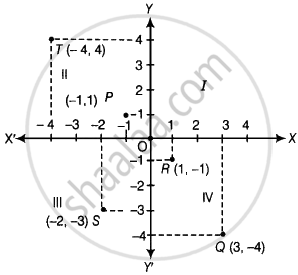
APPEARS IN
संबंधित प्रश्न
Plot the points (x, y) given in the following table on the plane, choosing suitable units of distance on the axes.
| x | -2 | -1 | 0 | 1 | 3 |
| y | 8 | 7 | -1.25 | 3 | -1 |
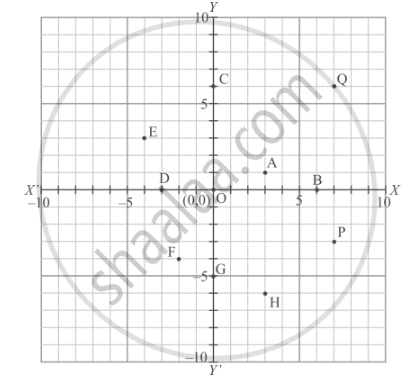
Write the coordinates of each of the following points marked in the graph paper:
Plot the following point in the coordinate system and identify the quadrant.
S(3, 5)
If P(−1, 1), Q(3, −4), R(1, −1), S(−2, −3) and T(−4, 4) are plotted on a graph paper, then the points in the fourth quadrant are __________
Plot the following point in a graph sheet.
E(0, −5)
Plot the following point in a graph sheet.
G(7, −4)
Plot the following point in a graph sheet.
J(8, −4)
Plot the following points and write the name of the figure obtained by joining them in order:
P(– 3, 2), Q(– 7, – 3), R(6, – 3), S(2, 2)
Plot the following points and check whether they are collinear or not:
(1, 3), (– 1, – 1), (– 2, – 3)
Plot the points A(1, – 1) and B(4, 5). Extend this line segment and write the coordinates of a point on this line which lies outside the line segment AB.
