Advertisements
Advertisements
प्रश्न
If cosec A – sin A = p and sec A – cos A = q, then prove that `("p"^2"q")^(2/3) + ("pq"^2)^(2/3)` = 1
Advertisements
उत्तर
cosec A – sin A = p ......[Given]
∴ `1/"sin A" - sin "A"` = p
∴ `(1 - sin^2"A")/"sin A"` = p
∴ `(cos^2"A")/"sin A"` = p ......`(i) [(because sin^2"A" + cos^2"A" = 1),(therefore 1 - sin^2"A" = cos^2"A")]`
sec A – cos A = q ......[Given]
∴ `1/"cos A" - cos "A"` = q
∴ `(1 - cos^2"A")/"cos A"` = q
∴ `(sin^2"A")/"cos A"` = q .....`[(because sin^2"A" + cos^2"A" = 1),(therefore 1 - cos^2"A" = sin^2"A")]`
L.H.S = `("p"^2"q")^(2/3) + ("pq"^2)^(2/3)`
= `[((cos^2"A")/(sin "A"))^2 ((sin^2"A")/(cos"A"))]^(2/3) + [((cos^2"A")/(sin "A"))((sin^2"A")/(cos"A"))^2]^(2/3)` ......[From (i) and (ii)]
= `((cos^4"A")/(sin^2"A") xx (sin^2"A")/(cos"A"))^(2/3) + ((cos^2"A")/(sin"A") xx (sin^4"A")/(cos^2"A"))^(2/3)`
= `(cos^3"A")^(2/3) + (sin^3"A")^(2/3)`
= cos2A + sin2A
= 1
= R.H.S
∴ `("p"^2"q")^(2/3) + ("pq"^2)^(2/3)` = 1
APPEARS IN
संबंधित प्रश्न
Prove the following identities:
`tan A - cot A = (1 - 2cos^2A)/(sin A cos A)`
Prove the following identities:
(cosec A – sin A) (sec A – cos A) (tan A + cot A) = 1
`sqrt((1-cos theta)/(1+cos theta)) = (cosec theta - cot theta)`
`(sin theta)/((sec theta + tan theta -1)) + cos theta/((cosec theta + cot theta -1))=1`
`(cot^2 theta ( sec theta - 1))/((1+ sin theta))+ (sec^2 theta(sin theta-1))/((1+ sec theta))=0`
If `sec theta + tan theta = x," find the value of " sec theta`
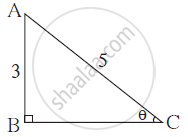
From the figure find the value of sinθ.
If `secθ = 25/7 ` then find tanθ.
What is the value of (1 + tan2 θ) (1 − sin θ) (1 + sin θ)?
If x = a sec θ and y = b tan θ, then b2x2 − a2y2 =
Prove the following identity :
`sin^2Acos^2B - cos^2Asin^2B = sin^2A - sin^2B`
Prove the following identity :
`(1 + cosA)/(1 - cosA) = tan^2A/(secA - 1)^2`
Prove the following identity :
`sqrt((1 + sinq)/(1 - sinq)) + sqrt((1- sinq)/(1 + sinq))` = 2secq
Prove the following identity :
`(cotA + cosecA - 1)/(cotA - cosecA + 1) = (cosA + 1)/sinA`
Without using trigonometric table , evaluate :
`cosec49°cos41° + (tan31°)/(cot59°)`
Prove that sin2 θ + cos4 θ = cos2 θ + sin4 θ.
Without using trigonometric table, prove that
`cos^2 26° + cos 64° sin 26° + (tan 36°)/(cot 54°) = 2`
If `sqrt(3)` sin θ – cos θ = θ, then show that tan 3θ = `(3tan theta - tan^3 theta)/(1 - 3 tan^2 theta)`
Prove that cot2θ × sec2θ = cot2θ + 1
Prove that `costheta/(1 + sintheta) = (1 - sintheta)/(costheta)`
