Advertisements
Advertisements
प्रश्न
1. I first met Private Quelch at the training depot. A man is liable to acquire in his firs week of Army life - together with his uniform, rifle and equipment- a nickname. Anyone who saw Private Quelch, lanky, stooping, frowning through horn-rimmed spectacles, understood why he was known as the Professor. Those who had any doubts on the subject lost them after five minutes' conversation with him.
2. I remember the first lesson we had in musketry. We stood in an attentive circle while a Sergeant, a man as dark and sun-dried as raisins, wearing North-West Frontier ribbons, described the mechanism of a service rifle.
3. "The muzzle velocity or speed at which the bullet leaves the rifle", he told us, "is
well over two thousand feet per second."
4. A voice interrupted. "Two thousand, four hundred and forty feet per second." It
was the Professor.
5. "That's right," the Sergeant said without enthusiasm, and went on lecturing. When he had finished, he asked us questions; and, perhaps in the hope of revenge, he turned with his questions again and again to the Professor. The only result was to enhance the Professor's glory. Technical definitions, the parts of a rifle, its use and care, he had them all by heart.
6. The Sergeant asked, "Have you had any training before?"
7. The Professor answered with a phrase that was to become familiar to all of us. "No, Sergeant. It's all a matter of intelligent reading."
8. That was our introduction to him. We soon learned more about him. He saw to that. He meant to get on, he told us. He had the brains. He was sure to get a commission, before long. As a first step, he meant to get a stripe.
9. In pursuit of his ambition he worked hard. We had to give him credit for that. He borrowed training manuals and stayed up late at nights reading them. He badgered the instructors with questions. He drilled with enthusiasm, and on route marches he was not only miraculously tireless but infuriated us all with his horrible heartiness. "What about a song, chaps?" is not greeted politely at the end of thirty miles. His salute at the pay table was a model to behold. When officers were in sight he would swing his skinny arms and march to the canteen like a Guardsman.
10. And day in and day out, he lectured to us in his droning, remorseless voice on every aspect of human knowledge. At first we had a certain respect for him, but soon we lived in terror of his approach. We tried to hit back at him with clumsy sarcasms and practical jokes. The Professor scarcely noticed; he was too busy working for his stripe.
11. Each time one of us made a mistake the Professor would publicly correct him. Whenever one of us shone, the Professor outshone him. When, after a hard morning's work of cleaning out our hut, we listened in silence to the Orderly Officer's praise, the Professor would break out with a ringing, dutifully beaming, "Thank you, sir!" And how superior, how condescending he was. It was always,
"Let me show you, fellow," or, "No, you'll ruin your rifle that way, old man."
12. We used to pride ourselves on aircraft recognition. Once, out for a walk, we heard the drone of a plane flying high overhead. None of us could even see it in the glare of the sun. Without even a glance upward the Professor announced, "That, of course, is a North American Harvard Trainer. It can be unmistakably identified by the harsh engine note, due to the high tip speed of the airscrew."
What could a gang of louts like us do with a man like that? 13. None of us will ever forget the
drowsy summer afternoon which was such a turning-point in the Professor's life.
14. We were sprawling contentedly on the warm grass while Corporal Turnbull was taking a lesson on the hand grenade.
15. Corporal Turnbull was a young man, but he was not a man to be trifled with. He had come back from Dunkirk with all his equipment correct and accounted for and his kitten in his pocket. He was
our hero, and we used to tell each other that he was so tough that you could hammer nails into him without his noticing it.
16. _"The outside of a grenade, as you can see," Corporal Turnbull was saying, "is divided up into a large number of fragments to assist segmentation"
17. "Forty-four"
18. "What's that?" The Corporal looked over his shoulder
19. "Forty-four segments." The Professor beamed at him.
20. The Corporal said nothing, but his brow tightened. He opened his mouth to
resume.
21. "And by the way, Corporal." We were all thunder-struck.
22. The Professor was speaking again. "Shouldn't you have started off with the five characteristics of the grenade? Our instructor at the other camp always used to do that, you know."
23. In the silence that followed a dark flush stained the tan of the Corporal's face. "Here," he said at last, "you give this lecture". As if afraid to say any more, he tossed the grenade to the Professor. Quite unabashed, Private Quelch climbed to his feet and with the attitude of a man coming into his birth-right gave us an unexceptionable lecture on the grenade.
24. The squad listened in a cowed, horrified kind of silence. Corporal Turnbull stood and watched, impassive, except for a searching intentness of gaze. When the lecture was finished he said, "Thank you, Private Quelch. Fall in with the others now." He did not speak again until we had fallen in and were waiting to be dismissed. Then he addressed us. 25. "As some of you may have heard," he began deliberately, "the platoon officer has asked me to nominate one of you for…." He paused and looked lingeringly up and down the ranks as if seeking final confirmation of decision.
26. So this was the great moment! Most of us could not help glancing at Private Quelch, who stood rigidly to attention and stared straight in front of him with an expression of self-conscious innocence.
27. ______"…..for permanent cookhouse duties, I've decided that Private Quelch is just the man for the job."
28. Of course, it was a joke for days afterwards; a joke and joy to all of us.
29. I remember, though.............
30. My friend Trower and I were talking about it a few days later. We were returning from the canteen to our own hut.
31. Through the open door, we could see the three cooks standing against the wall as if at bay; and from within came the monotonous beat of a familiar voice.
32. "Really. I must protest against this abominably unscientific and unhygienic method of peeling potatoes. I need to only draw your attention to the sheer waste of vitamin values.............."
33. We fled.
About the Author
Alexander Baron (1917-1999) has written many novels, including 'There's no Home',
' The Human Kind', 'Queen of the East', 'Seeing Life' and The How Life', along with
film scripts and television plays. He started life as an Asstt. Editor of The Tribune and
later edited the 'New Theater.' He served in the army during the Second World War.
Advertisements
उत्तर
Attempt yourself.
APPEARS IN
संबंधित प्रश्न
Before you read "Keeping It From Harold", the teacher will encourage you to answer or discuss the following.
- What are the different weight categories in Boxing?
- Have you ever heard the song whose lyrics go like...."He floats like a butterfly and stings like a bee"? Who does 'he' refer to? He is also known as 'The Greatest' boxer of all times. What was his original name? How many times did he win the World Heavyweight Belt?
- Find out from your friend if he /she watches WWE and who is his/her favourite wrestler. Also find out why he/she likes this wrestler.
- Discuss with your friend as to why these wrestlers have such a large fan following. Has the perception of the people changed over the century with respect to those who fight in the ring?
Read the comic strip based on. H.G. Wells' novells.


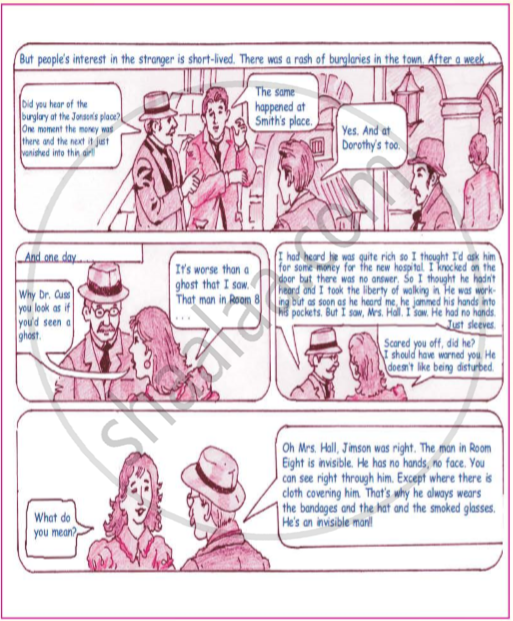
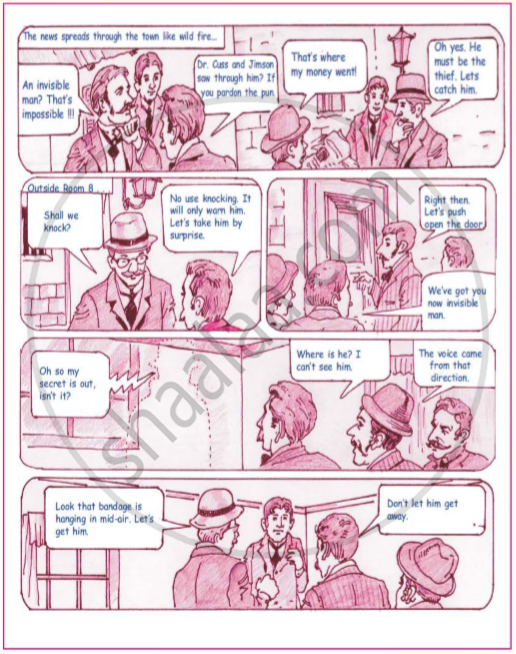
Answer the questions by ticking the correct option.
(a) The strange-looking man wanted ....
(i) the best room at the inn.
(ii} a room with a fire and a good lock.
(iii} a room with a good view.
(iv) a room where he could work quietly.
(b) Jimson was suspicious of the stranger because ...
(i} he did not answer Jimson's questions.
(ii} he did not want to talk about the weather.
(iii} he kept his back turned towards Jimson at all times.
(iv) he shouted atJimson when he entered his room.
(c) The people of the town gossiped about the stranger as ...
(i} he did not go out or talk to anyone in the town.
(ii} he had met with an accident and his face was bandaged.
(iii} he was new to the town and behaved rudely.
(iv) he stayed in his room and did not show his face to anyone.
(d) 'There was a rush of burglaries in the town. This means that ________
(i} there were many robberies in the town.
(ii) a few people in the town had seen a rob her.
(iii} the burglaries in the town were done in a rush.
(iv) the burglar was a rash and careless man.
(e) Although Jimson and Dr Cuss are suspicious of the strange guest, Mrs Hall tolerates him because ....
(i} she is not superstitious or ignorant.
(ii) she is sorry for the stranger who is bandaged.
(iii} the stranger is paying her a good amount of money for the room.
(iv} the stranger is polite and kind to Mrs Hall at all times.
(f) The stranger who was staying at the inn can be described as being ....
(I} violent
(ii} upright
(iii} dishonest
(iv) sensible
The black man's face bespoke revenge
As the fire passed from his sight.
For all he saw in his stick of wood
Was a chance to spite the white.
The last man of this forlorn group
Did nought except for gain.
Giving only to those who gave
Was how he played the game.
Their logs held tight in death's still hands
Was proof of human sin.
They didn't die from the cold without
They died from the cold within.
Read the lines given above and answer the question that follow.
What was the obvious cause of their deaths ?
The blocks were all lined up for those who would use them
The hundred-yard dash and the race to be run
These were nine resolved athletes in back of the starting line
Poised for the sound of the gun.
The signal was given, the pistol exploded
And so did the runners all charging ahead
But the smallest among them,he stumbled and staggered
And fell to the asphalt instead.
He gave out a cry in frustration and anguish
His dreams ands his efforts all dashed in the dirt
But as sure I'm standing here telling this story
The same goes for what next occurred.
Read the lines given above and answer the following question:
Did all hope to win? How do you know? Why did the eight runners pull up on their heels?
It was my business to cross the bridge, explore the bridge head 3 beyond and find out to what point the enemy had advanced. I did this and returned over the bridge. There were not so many carts now and very few people on foot, but the old man was still there.’’Where do you come from?” I asked him.
“From San Carlos,” he said, and smiled.
That was his native town and so it gave him pleasure to mention it and he smiled.
“I was taking care of animals,” he explained.
“Oh,” I said, not quite understanding.
“Yes,” he said, “I stayed, you see, taking care of animals. I was the last one to leave the town of San Carlos.”
He did not look like a shepherd nor a herdsman and I looked at his black dusty clothes and his gray dusty face and his steel rimmed spectacles and said, “What animals were they?”
“Various animals,” he said, and shook his head. “I had to leave them.”
Read the extract given below and answer the question that follow.
What did the narrator see on the bridge when he returned?
Its a cruel thing to leave her so.”
“Then take her to the poorhouse: she’ll have to go there,” answered the blacksmith’s wife, springing away, and leaving Joe behind.
For a little while the man stood with a puzzled air; then he turned back, and went into the hovel again. Maggie with painful effort, had raised herself to an upright position and was sitting on the bed, straining her eyes upon the door out of which all had just departed, A vague terror had come into her thin white face.
“O, Mr. Thompson!” she cried out, catching her suspended breath, “don’t leave me here all alone!” ,
Though rough in exterior, Joe Thompson, the wheelwright, had a heart, and it was very tender in some places. He liked children, and was pleased to have them come to his shop, where sleds and wagons were made or mended for the village lads without a draft on their hoarded sixpences.
“No, dear,” he answered, in a kind voice, going to the bed, and stooping down over the child, “You she’n’t be left here alone.” Then he wrapped her with the gentleness almost of a woman, in the clean bedclothes which some neighbor had brought; and, lifting her in his strong arms, bore her out into the air and across the field that lay between the hovel and his home.
Read the extract given below and answer the question that follow.
What assurance did Joe Thompson give Maggie? What did he do?
“You haven’t brought home that sick brat!” Anger and astonishment were in the tones of Mrs. Joe Thompson; her face was in a flame.
“I think women’s hearts are sometimes very hard,” said Joe. Usually Joe Thompson got out of his wife’s way, or kept rigidly silent and non-combative when she fired up on any subject; it was with some surprise, therefore, that she now encountered a firmly-set countenance and a resolute pair of eyes.
“Women’s hearts are not half so hard as men’s!”
Joe saw, by a quick intuition, that his resolute bearing h«d impressed his wife and he answered quickly, and with real indignation, “Be that as it may, every woman at the funeral turned her eyes steadily from the sick child’s face, and when the cart went off with her dead mother, hurried away, and left her alone in that old hut, with the sun not an hour in the sky.”
“Where were John and Kate?” asked Mrs. Thompson.
“Farmer Jones tossed John into his wagon, and drove off. Katie went home with Mrs. Ellis; but nobody wanted the poor sick one. ‘Send her to the poorhouse,’ was the cry.”
“Why didn’t you let her go, then. What did you bring her here for?”
“She can’t walk to the poorhouse,” said Joe; “somebody’s arms must carry her, and mine are strong enough for that task.”
Read the extract given below and answer the question that follow.
How did Joe counter his wife on her remark about Maggie?
What information does Gilman give to Twisden? Why did Twisden decide to withdraw from the case ?
Author’s friend had taken out the parts of the bicycle easily, but he really had tough time fixing them Explain this with suitable example.
Who were wrongly blamed for the theft of the bananas?
What do you know about ‘That way?
How did different companies affect the character and behaviour of the two birds?
What is the most obvious advantage of sleep?
Narrate the story of the reptiles as told by Zai Whitaker in not more than 80 words.
Read the lines in which the following phrases occur. Then discuss with your partner the meaning of each phrase in its context.
amazing mound
Make noun from the word given below by adding –ness, ity, ty or y
Active ___________.
The words given against the sentences below can be used both as nouns and verbs. Use them appropriately to fill in the blanks.
(i) He said he _________________________ to be invited to the party. (hope)
(ii) We gave up _______________________ of his joining the party.
What does the speaker usually do while lying in the bed?
The words helper, companion, partner and accomplice have very similar meanings, but each word is typically used in certain phrases. Can you fill in the blanks below with the most commonly used words? A dictionary may help you.
my ……………. on the journey.
In Act V of the play Macbeth, which one of the following do you think reflects the tragic arc of the play?
(P) Macbeth’s soliloquy; “Out, out brief candle, Life’s but a walking shadow.”
(Q) Lady Macbeth’s breakdown: “What’s done cannot be undone.”
(R) Macduff’s greeting: “Hail, King of Scotland.”
(S) Malcolm’s final words: “So, thanks to all at once and to each one, whom we invite to see us crowned at Scone.”
