Advertisements
Advertisements
प्रश्न
What decides the choices made by the rebel?
Advertisements
उत्तर
The society’s opinion can never be a rebel’s Choice. The rebel’s choices are based on what the Society would not accept or agree to.
संबंधित प्रश्न
Answer the following question in 30 to 40 words.
How was the problem of what to do with Bruno finally solved?
The Narrative Present
Notice the incomplete sentences in the following paragraphs. Here the writer is using incomplete sentences in the narration to make the incident more dramatic or immediate. Can you rewrite the paragraph in complete sentences?
(You can begin: The vet and I made a dash back to the car. Bruno was still floundering…)
(i) A dash back to car. Bruno still floundering about on his stumps, but clearly weakening rapidly; some vomiting, heavy breathing, with heaving flanks and gaping mouth. Hold him everybody! In goes the hypodermic – Bruno squeals – 10 c.c. of the antidote enters his system without a drop being wasted. Then minutes later: condition unchanged! Another 10 c.c. injected! Ten minutes later: breathing less stertorous – Bruno can move his arms and legs a little although he cannot stand yet. Thirty minutes later: Bruno gets up and has a great feed! He looks at us disdainfully, as much as to say, ‘What’s barium carbonate to a big black bear like me?’ Bruno is still eating.
(ii) In the paragraphs above from the story the verbs are in the present tense (eg. hold, goes, etc.). This gives the reader an impression of immediacy. The present tense is often used when we give a commentary on a game (cricket, football, etc.), or tell a story as if it is happening now. It is, therefore, called the narrative present. You will read more about the present tense in Unit 10
Answer following question in short.
How did kangaroos react to duck’s request?
What havoc has the super cyclone wreaked in the life of the people of Orissa?
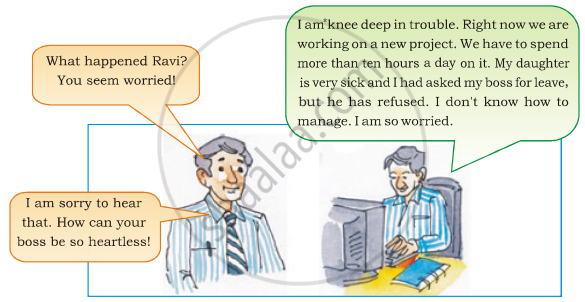
Read the following conversation between two friends.
Is it possible to make accurate guesses about the people you have never met? Read the poem, to see how conclusions can be drawn about people.
Abandoned Farmhouse
He was a big man, says the size of his shoes On a pile of broken dishes by the house; A tall man too, says the length of the bed In an upstairs room; and a good, God-fearing man, Says the Bible with a broken back On the floor below a window, bright with sun; But not a man for farming, say the fields Cluttered with boulders and a leaky barn.
A woman lived with him, says the bedroom wall Papered with lilacs and the kitchen shelves Covered with oilcloth, and they had a child Says the sandbox made from a tractor tyre. Money was scarce, say the jars of plum preserves And canned tomatoes sealed in the cellar-hole, And the winters cold, say the rags in the window frames. It was lonely here, says the narrow country road.
Something went wrong, says the empty house In the weed-choked yard. Stones in the fields Say he was not a farmer; the still-sealed jars In the cellar say she left in a nervous haste. And the child? Its toys are strewn in the yard Like branches after a storm - a rubber cow, a rusty tractor and a broken plow, a doll in overalls. Something went wrong, they say. Ted Kooser
It was my business to cross the bridge, explore the bridge head 3 beyond and find out to what point the enemy had advanced. I did this and returned over the bridge. There were not so many carts now and very few people on foot, but the old man was still there.’’Where do you come from?” I asked him.
“From San Carlos,” he said, and smiled.
That was his native town and so it gave him pleasure to mention it and he smiled.
“I was taking care of animals,” he explained.
“Oh,” I said, not quite understanding.
“Yes,” he said, “I stayed, you see, taking care of animals. I was the last one to leave the town of San Carlos.”
He did not look like a shepherd nor a herdsman and I looked at his black dusty clothes and his gray dusty face and his steel rimmed spectacles and said, “What animals were they?”
“Various animals,” he said, and shook his head. “I had to leave them.”
Read the extract given below and answer the question that follow.
What gave the old man pleasure?
The women came out on the shore, and made for the stepping—?stones. They had plenty to laugh and bicker about, as they approached the river in a noisy crowd. They girded up their skirts, so as to jump from stone to stone, and they clanked their sickles and forks together over their shoulders to have ease of movement. They shouted their quarrels above the gush of the river. Noise frightens crocodiles. The big mugger did not move, and all the women crossed in safety to the other bank. Here they had to climb a steep hillside to get at the grass, but all fell to with a will, and sliced away at it wherever there was foothold to be had. Down below them ran the broad river, pouring powerfully out from its deep narrow pools among the cold cliffs and shadows, spreading into warm shallows, lit by kingfishers. Great turtles lived there, and mahseer weighing more than a hundred pounds. Crocodiles too. Sometimes you could see them lying out on those slabs of clay over there, but there were none to be seen at the moment.
Read the extract given below and answer the question that follow.
Why did they shout louder than the sound of the water?
As it turned out, Luz broke his own past record. In doing so, he pushed me on to a peak performance. I remember that at the instant I landed from my final jump—the one which set the Olympic record of 26 feet 5-5/16 inches—he was at my side, congratulating me. Despite the fact that Hitler glared at us from the stands not a hundred yards away, Luz shook my hand hard—and it wasn’t a fake “smile with a broken heart” sort of grip, either.
You can melt down all the gold medals and cups I have, and they couldn’t be a plating on the 24-carat friendship I felt for Luz Long at that moment. I realized then, too, that Luz was the epitome of what Pierre de Coubertin, founder of the modern Olympic Games, must have had in mind when he said, “The important thing in the Olympic Games is not winning but taking part. The essential thing in life is not conquering but fighting well.”
Read the extract given below and answer the question that follow.
What, according to Coubertin, is the true spirit of the Olympics? Explain the reference to Coubertin.
Read the extract given below and answer the questions that follow:
Portia: ........But this reasoning is not in fashion to choose me a husband. O me, the word “choose”! I may neither choose who I would nor refuse whom I dislike; so is the will of a living daughter curbed by the will of a dead father. Is it not hard, Nerissa, that I cannot choose one, nor refuse none?
(i) What test had Portia’s father devised for her suitors? What oath did the suitors have to take before making their choice? [3]
(ii) Who is Nerissa? What does she say to cheer up Portia? [3]
(iii) Why does Portia disapprove of the County Palatine? Who would she rather marry? [3]
(iv) How, according to Portia, can the Duke of Saxony’s nephew be made to choose the wrong casket? What do these suitors ultimately decide? Why? [3]
(v) Whom does Portia ultimately marry? Who were the two other suitors who took the test? Why, in your opinion, is the person whom she marries worthy of her? [4]
Which casket does Arragon finally choose? Whose portrait does he find inside? Which casket actually contains Portia's portrait?
Answer the following questions with reference to Jack London's, 'The Call of the Wild'.
(i) How was Thornton talked into a wager that involved Buck, during a conversation in the Eldorado Saloon?
(ii) How did Thornton feel after he had committed Buck to the wager?
(iii) Give a brief description of how Buck managed to win the wager for Thornton.
Describe Golu’s meeting with the crocodile.
Narrate the tale of two birds in your own words.
What made the farmer’s wife blind with rage?
What do you know about Tansen’s life before he joined Akbar’s court?
Do you agree that it is difficult not to go along with someone who is very strong and powerful? Express your views frankly and clearly.
How did the forest become normal and peaceful again?
What made the ghost speechless? Why?
ind the word that refers to the snake’s movements in the grass.
