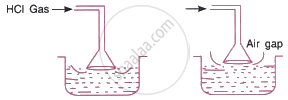
Hydrogen chloride gas is very soluble in water. It is dissolved in water to prepare hydrochloric acid by using an anti-suction device, as shown in the diagram. Very briefly explain, how this device
Advertisements
प्रश्न
Hydrogen chloride gas is very soluble in water. It is dissolved in water to prepare hydrochloric acid by using an anti-suction device, as shown in the diagram. Very briefly explain, how this device prevents the suction of water into the flask, in which hydrogen chloride gas is produced.
Advertisements
उत्तर
An inverted funnel connected to the HCl gas supply is placed in a beaker so that the rim of the funnel just touches the surface of the water. HCl gas enters through the delivery tube, fills the mouth of the funnel, and then dissolves in water. Hence, a low pressure is created, and back suction occurs. As a result, the water level rises in the funnel, and the water level in the beaker drops. Thus, the rim of the funnel loses contact with water and the outside air rushes in through the gap to equalise the pressure on either side of the funnel. The solution falls back into the beaker due to gravity. The water level then falls, and the funnel drops back to its original position.
APPEARS IN
संबंधित प्रश्न
The aim of the Fountain experiment is to prove that ______.
Name the following:
Gas obtained by treating metals with hydrochloric acid.
Name the drying agent used to dry HCl gas.
How can you prove that hydrochloric acid contain :
Chlorine?
Name two gases which combine chemically to form a solid.
Give reason for the following:
Dilute hydrochloric acid cannot be concentrated by distilling (boiling) the dilute acid.
Dilute hydrochloric acid is added in turn to a mixture of iron and sulphur and to the compound formed between iron and sulphur. Name the gas formed in each case.
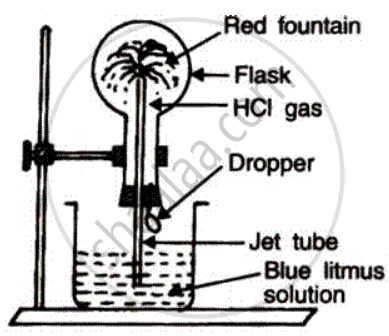
(a) Name the experiment illustrate above.
(b) Which property of hydrogen chloride is demonstrated by this experiment?
(c) State the colour of the water that has entered the round-bottomed flask.
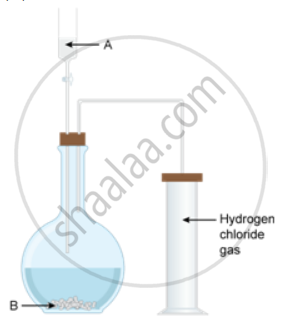
The diagram shows an apparatus for the laboratory preparation of hydrogen chloride.
(i) Identify A and B
(ii) Write the equation for the reaction
(iii) How would you check whether or not the gas jar is filled with hydrogen chloride?
(iv) What does the method of collection tell you about the density of hydrogen chloride.
Study the figure given below and answer that questions that follow: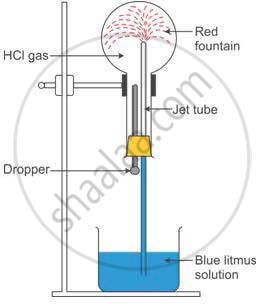
(i) Identify the gas Y.
(ii) What property of gas Y does this experiment demonstrate?
(iii) Name another gas which has the same property and can be demonstrated through this experiment.
