Advertisements
Advertisements
प्रश्न
How will you bring about the following conversion?
1-Chlorobutane to n-octane
How will you bring about the following conversion in not more than two steps?
1-Chlorobutane to n-octane
Advertisements
उत्तर
\[\ce{\underset{1-Chlorobutane}{2CH3CH2CH2CH2Cl} + 2Na ->[dry ether][Wurtz reaction] \underset{n-octane}{CH3CH2CH2CH2 - CH2CH2CH2CH3} + 2NaCl}\]
APPEARS IN
संबंधित प्रश्न
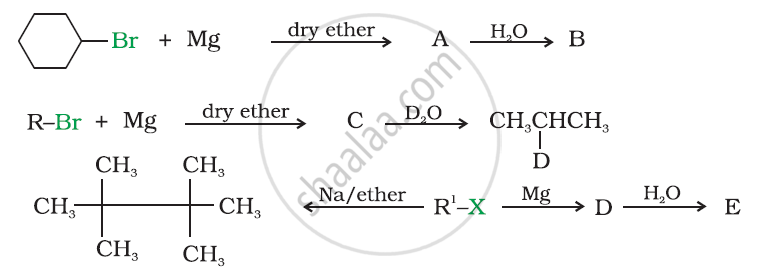
Identify A, B, C, D, E, R and R1 in the following:
How will you bring about the following conversion?
Bromomethane to propanone
Explain why Grignard reagents should be prepared under anhydrous conditions?
How the following conversion can be carried out?
2-Chlorobutane to 3, 4-dimethylhexane
Write the structure of main compounds A and B in the following reaction: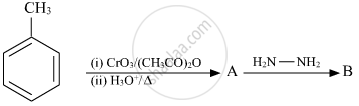
Which one of the following produces acyl halide by treatment with PCl5?
What would be the reactant and reagent used to obtain 2, 4-dimethyl pentan-3-ol?
Which of the following statements are correct about the reaction intermediate?

(i) Intermediate (c) is unstable because in this carbon is attached to 5 atoms.
(ii) Intermediate (c) is unstable because carbon atom is sp2 hybridised.
(iii) Intermediate (c) is stable because carbon atom is sp2 hybridised.
(iv) Intermediate (c) is less stable than the reactant (b).
\[\ce{R - CH2 - CCl2 - R ->[Peagent] R - C ≅ C - R}\]. The reagent is:-
Grignard reagent shows addition on
The product formed in the first step of the reaction
\[\begin{array}{cc}
\ce{Br}\phantom{......}\\
|\phantom{.......}\\
\ce{CH3-CH2-CH-CH2-CH-CH3}\\
\phantom{...............}|\\
\phantom{................}\ce{Br}
\end{array}\]
with excess Mg/Et2O(Et = C2H5) is:
Explain why Grignard reagents should be prepared under anhydrous conditions.
Explain why Grignard reagents should be prepared under anhydrous conditions?
Explain why Grignard reagents should be prepared under anhydrous conditions?
Explain why Grignard reagents should be prepared under anhydrous conditions?
Explain why Grignard reagents should be prepared under anhydrous conditions?
