Advertisements
Advertisements
प्रश्न
How does the two sounds of same loudness and same pitch produced by different instruments differ? Draw diagrams to illustrate your answer.
Advertisements
उत्तर
The two sounds of the same loudness and pitch produced by different instruments differ due to their different waveforms.
The waveforms depend on the number of the subsidiary notes and their relative amplitude along with the principal note.
The diagram below shows the wave patterns of two sounds of the same loudness and pitch emitted by two different instruments. They produce different sensations in the ears because they differ in waveforms: one is a sine wave, while the other is a triangular wave.

APPEARS IN
संबंधित प्रश्न
An enemy plane is at a distance of 300 km from a radar. In how much time the radar will be able to detect the plane? Take velocity of radio waves as 3 × 10⁸ ms−1.
The pitch of a flute is decreased by ................... length of air column.
What is longitudinal wave?
Figure shows four waves A, B, C, and D
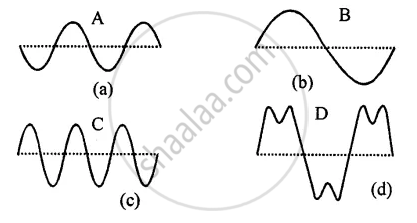
Name the wave which shows
(a) a note from a musical instrument,
(b) a soft note
(c) a shrill note.
- Which of the following quality determines the loudness of a sound wave?
- wavelength
- frequency and
- amplitude
- How is loudness related to the quantity mentioned above in part (a)?
Name the unit in which loudness of sound is measured.
The same musical note when played on a piano and when played on a flute sounds different.
What is the noise? Give an example.
Two musical notes of the same pitch and loudness are played on a violin and a piano. Their waveforms are as shown in the figure below:
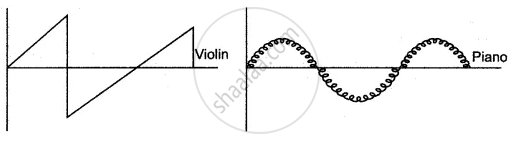
Give scientific reasons.
In earlier times, people used to listen for the arrival of a distant train by putting their ear to the rail.
