Advertisements
Advertisements
प्रश्न
How does Ravi get milk for the kitten?
Advertisements
उत्तर
Ravi got milk for the kitten from the kitchen. When his grandmother Paati saw him holding the glass of milk, he told her that he was hungry. In order to avoid suspicion, he had to even drink most of the milk. When she asked for the tumbler, he told her that he would wash it himself. Then, he ran and poured the milk into a coconut shell. Before his grandmother could get really suspicious, he ran back to the kitchen, washed the tumbler and put it back.
संबंधित प्रश्न
Thinking about the Text
Given below are some emotions that Kezia felt. Match the emotions in Column A with
the items in Column B.
| A | B |
| 1. Fear or terror | (i) Father comes into her room to give her a goodbye kiss |
| 2. glad sense of relief | (ii) Noise of the carriage grows fainter |
| 3. a “funny” feeling, perhaps of understanding |
(iii) Father comes home |
| (iv) Speaking to father | |
| (v) Going to bed when alone at home | |
| (vi) Father comforts her and falls asleep | |
| (vii) Father stretched out on the safa. snoring |
Name all the people who are tried in the king’s court, and give the reasons for their trial.
Now rewrite the pair of sentences given below as one sentence.
He gave the little girl an apple. He took the computer apart.
Based on your reading of the story answer the following question by choosing the correct option:
With reference to Hooper, the author says, “Every thing was going for him”. What does it imply?
Understanding determiners.
Determiners are words that are used in front of nouns to indicate whether you are
referring to something specific or something of a particular type.
Singular nouns always need a determiner. In plural nouns, the determiner is
optional. Determiners may or may not be used with uncountable nouns depending
on context.
There are about 50 different determiners in the English language which include:
Articles: a, an, the
Possessives: my, your, our, their, his, hers, whose, etc.
Demonstratives: this, that these, those, which, etc.
Quantifiers: few, a few, many, much, each, every, some, any, etc.
Number: one, two, three, twenty, forty, etc.
Ordinals: first, second, last, next, etc.
Determiners are used
• to state the unit/ number of people, things or other nouns.
• to state possessives.
• to specify someone or something.
• to state how things or people are distributed.
• to state the difference between nouns.
Determiners can be classified under the following categories:
| EXAMPLES | ||
| MULTIPLIERS | double, twice, three times... | We want double portions. |
| FRACTIONS | half, a third, two fifths ..... | I drove at half speed. |
| INTENSIFIERS | What! Such! | Such impudence! |
| QUANTIFIERS | all, both, most | I like most people. |
| ARTICLES | a, an, the | Get a book from the shelf. |
| DEMONSTRATIVES | this, that, these, those, another, other | That tree is in another garden. |
| DISTRIBUTIVES | each, every, either, neither | I have a gift for each person. |
| POSSESSIVES | ||
| (i) PRONOMINAL | my, your, his, her, its, our, your, their | You can borrow Kim's video. |
| (ii) NOMINAL | Renata's, Adam's, People's ... | You can borrow my video. |
| INTERROGATIVES | What? Which? Whose? | Whose book is that? |
| QUANTIFIERS | some, any, no | I have no problem with them. |
| CARDINAL NUMBERS | one, two, three hundred ..... | Two heads are better than one. |
| ORDINAL NUMBERS | first, fewer, much, more, less, least ......... . | It was my first tennis match. |
| QUANTIFIERS | ||
| (i) SIMPLE | few, fewer, much, more, less, least ........... . |
I have few pals; Kim has more. |
| (ii) COMPOUND | a little, a lot of, a great deal of .... |
I have lots of time to spare. |
Working in groups of four, create your own mystery story. You may use the following chart to plan your story.
| Title of ‘Solve-it Story’ | |
| Main Character | |
| Secondary character | |
| Setting (where and when) | |
| Problem | |
| Main events | |
| Climax | |
| Solution/Conclusion |
Some are meet for a maiden's wrist,
Silver and blue as the mountain mist,
Some are flushed like the buds that dream
On the tranquil brow of a woodland stream,
Some are aglow with the bloom that cleaves
To the limpid glory of new born leaves
Read the lines given above and answer the question that follow.
Mention the colours that are given or hinted at to describe the bangles.
And is mine one?' said Abou.
'Nay, or not so,'Replied the angel,
Abou spoke more low,
But cheery still; and said ,'I pray thee, then,
Write me as one that loves His fellow men.'
Read the lines given above and answer the following question.
What did Adhem ask the angel again when the angel told Adhem that he was “writing the names of those who love the Lord?”
The village consisted of less than thirty houses, only one of them built with brick and cement. Painted a brilliant yellow and blue all over with gorgeous carvings of gods and gargoyles on its balustrade, it was known as the Big House. The other houses, distributed in four streets, were generally of bamboo thatch, straw, mud, and other unspecified material. Muni’s was the last house in the fourth street, beyond which stretched the fields. In his prosperous days Muni had owned a flock of forty sheep and goats and sallied forth every morning driving the flock to the highway a couple of miles away.
Read the extract given below and answer the question that follow.
What did Muni feed his flock with? When did he come back home? What did he carry home?
What test had Portia’s father devised for her suitors? What oath did the suitors have to take before making their choice?
Discuss in small groups
• If you want to give away something of your own to the needy, would it be better to ask your elders first?
What made the farmer’s wife blind with rage?
Why did Vijay Singh ask the ghost to accompany him to town next day?
Fans don’t talk, but it is possible to imagine that they do. What is it, then, that sounds like the fan’s chatter?
Read the lines in which the following phrases occur. Then discuss with your partner the meaning of each phrase in its context.
meadow houses
Put these sentences from the story in the right order and write them out in a paragraph. Don’t
refer to the text.
-
I shall be so glad when today is over.
-
Having a leg tied up and hopping about on a crutch is almost fun, I guess.
-
I don’t think I’ll mind being deaf for a day — at least not much.
-
But being blind is so frightening.
-
Only you must tell me about things.
-
Let’s go for a little walk.
-
The other bad days can’t be half as bad as this.
What did the speaker do while hiding himself in the banyan tree branches?
Why does Radha’s mother tell her that it is not suitable for girls to climb trees? Find points to agree with Radha or her mother. Plan what you will say by making notes like this:
- Girls should be able to climb trees if they wish
1. ___________________________
2. ___________________________
3. ___________________________ - Girls should not be allowed to climb trees
1. ___________________________
2. ___________________________
3. ___________________________
Now divide the class into two groups. Present to the rest of the class the opinion of Radha who thinks there is no harm in girls climbing trees and of her mother who thinks girls should not do this.
Multiple Choice Question:
Such silly questions are baseless, still ______
Look at the following picture. One asks a question, the other answers it. Then the answer is noted in a form as shown below.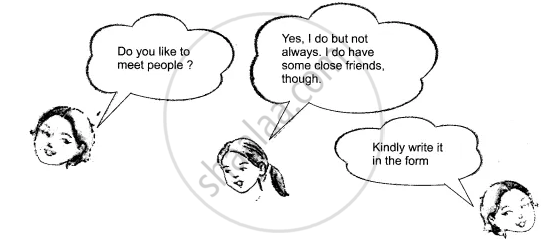
| Questions | Yes/No | Additional Response |
|
1. Do you like to meet people? |
Yes I do, but not always | I do have some close friends, though. |
|
2. Do you like the area you live in? |
No, I Don't | But I have no choice |
