Advertisements
Advertisements
प्रश्न
How can you obtain pure water from a salt-water mixture (or salt-solution) ? Draw a neat and labelled diagram of the apparatus you would use to obtain pure water from a salt-water mixture (or salt-solution).
Advertisements
उत्तर
We can obtain pure water from a saltwater mixture (or salt solution) by the process of distillation. Important steps underlying the process are as follows:
The salt water mixture is taken in a distillation flask and heated subsequently.
On heating, water vapours are formed that rise up and come through the side tube B.
It is then passed through condenser C.
Cold water from the tap is circulated in the outer tube of the condenser, so that the hot vapours are cooled.
The vapours condense and are collected in another beaker.
This pure water is called distilled water.
Salt, being non-volatile, remains in the flask and can be obtained later.
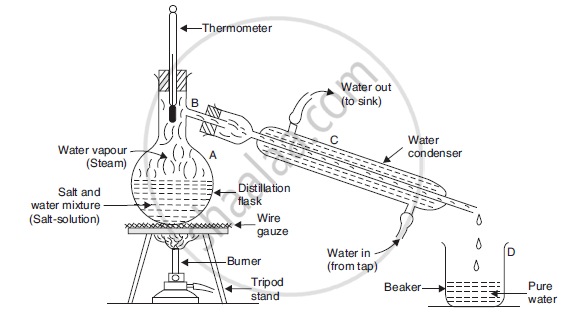
Separation by distillation. Here a mixture of salt and water (or salt-solution) is being separated by distillation.
APPEARS IN
संबंधित प्रश्न
Name the processes involved in two cases.
Write true or false for each statement. Rewrite the false statement correctly.
Matter cannot exist in different states.
What are the conditions for 'something' to be called 'matter'?
State two characteristics of matter demonstrated by Brownian motion.
Name a non-metal which is a good conductor of electricity.
What is meant by saying that metals are malleable and ductile?
The element which is not common between the compounds called baking soda and soda ash is
The property/properties which enable copper metal to be used for making electric wires is/are :
Out of a colloid, solution and a suspension :
which one has the smallest particles ?
Name the process which can be used to purify an impure sample of copper sulphate.
Which of the following cannot be separated from air by the process of fractional distillation ?
Differentiate between the-two characteristics of matter – ‘mass’ & ‘weight’.
Diffentiate between absorption and adsorption.
You want to wear your favourite shirt to a party, but the problem is that it is still wet after a wash. What steps would you take to dry it faster?
Celsius scale is a scale of temperature in which zero represents the melting point of ice and 100 represents the boiling point of water.
Complete the following table:
| S.No. | CELSIUS | KELVIN |
| 1. | 90°C | 363 K |
| 2. | ______ | 283 K |
| 3. | 63 °C | ______ |
| 4. | 250°C | ______ |
| 5. | ______ | 303 K |
Intermolecular space is maximum in ______.
The pressure of gases does not depend on the temperature of the gas and the volume it occupies.
Gases do not diffuse very easily.
Define the term matter.
