Advertisements
Advertisements
प्रश्न
How can you obtain pure water from a salt-water mixture (or salt-solution) ? Draw a neat and labelled diagram of the apparatus you would use to obtain pure water from a salt-water mixture (or salt-solution).
Advertisements
उत्तर
We can obtain pure water from a saltwater mixture (or salt solution) by the process of distillation. Important steps underlying the process are as follows:
The salt water mixture is taken in a distillation flask and heated subsequently.
On heating, water vapours are formed that rise up and come through the side tube B.
It is then passed through condenser C.
Cold water from the tap is circulated in the outer tube of the condenser, so that the hot vapours are cooled.
The vapours condense and are collected in another beaker.
This pure water is called distilled water.
Salt, being non-volatile, remains in the flask and can be obtained later.
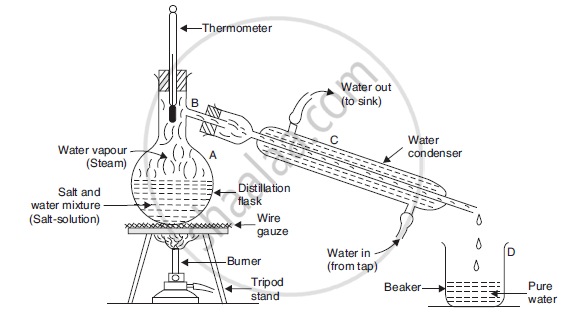
Separation by distillation. Here a mixture of salt and water (or salt-solution) is being separated by distillation.
APPEARS IN
संबंधित प्रश्न
Match the following
| Column A | Column B | ||
| (a) | Molecules | (i) | Water boils |
| (b) | 100° C | (ii) | Evaporation |
| (c) | 0° C | (iii) | Changes from solid to gas |
| (d) | At all temperatures | (iv) | Matter |
| (e) | Camphor | (v) | Water freezes |
Name the terms for the change of a solid into liquid.
Write true or false for each statement. Rewrite the false statement correctly.
Matter cannot exist in different states.
What are the conditions for 'something' to be called 'matter'?
What name is given to those elements which are neither good conductors of electricity like copper nor insulators like sulphur ?
Which of the following are ‘pure substances’ ?
Ice, Milk, Iron, Hydrochloric acid, Calcium oxide, Mercury, Brick, Wood, Air
State two physical properties on the basis of which metals can be distinguished from non-metals.
You are given two liquids, one a solution and the other a compound. How will you distinguish the solution from the compound ?
Iron powder and sulphur powder were mixed together and divided into two parts A and B. When part A was heated strongly over a burner, then a substance C was formed. The part B was, however, not heated at all. When dilute hydrochloric acid was added to substance C, then gas D was evolved and when dilute hydrochloric acid was added to part B then gas E was evolved.
- What type of substance is B ?
- What type of substance is C ?
- Name the gas (i) D, and (ii) E ?
- State one characteristic property of gas D.
- Write one test to identify gas E.
21.5 g of sodium chloride dissolves in 60 g of water at 25°C. Calculate the solubility of sodium chloride in water at that temperature.
What is the difference between colloids and suspensions ?
State whether the following statement are true or false :
Salt and water can be recovered from an aqueous salt solution by the process of evaporation.
How will you separate a mixture of iron filings and powdered carbon ?
How will you separate camphor, common salt and iron nails from their mixture ?
You are given a mixture of iodine in alcohol called tincture iodine. Which method will you use to recover both, iodine as well as alcohol, from this mixture ?
Why wires cannot be drawn from materials such as stone or wood?
State whether true or false. If false, correct the statement.
Oil and water are immiscible with each other.
Match the physical quantities given in column A to their S I units given in column B:
| (A) | (B) | ||
| (a) | Pressure | (i) | cubic metre |
| (b) | Temperature | (ii) | kilogram |
| (c) | Density | (iii) | pascal |
| (d) | Mass | (iv) | kelvin |
| (e) | Volume | (v) | kilogram per cubic metre |
Define the term matter.
