Advertisements
Advertisements
प्रश्न
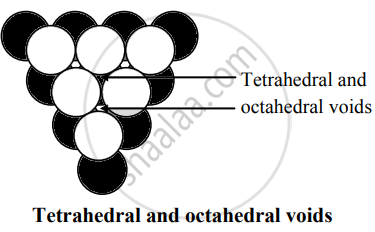
How are tetrahedral and octahedral voids formed?
Advertisements
उत्तर
- Two dimensional hexagonal close-packed layer has triangular voids which is formed by three spheres.
- When the triangular voids of the first layer are covered by spheres of the next layer, tetrahedral voids are formed. A tetrahedral void is surrounded by four spheres.
- The overlapping triangular voids from the two layers together form an octahedral void.
An octahedral void is surrounded by six spheres. - Thus, the depressions in which spheres of second layer rest are tetrahedral voids while the depressions in which no sphere rests are octahedral voids.
APPEARS IN
संबंधित प्रश्न
The density of iron crystal is 8.54-gram cm–3. If the edge length of the unit cell is 2.8 A° and atomic mass is 56 gram mol–1, find the number of atoms in the unit cell. (Given: Avogadro's number = 6.022x1023,1A° = 1x10⁻⁸ cm)
Choose the most correct answer.
A compound forms hcp structure. Number of octahedral and tetrahedral voids in 0.5 mole of substance is respectively _______.
Answer the following in one or two sentences.
Sketch a tetrahedral void.
Answer the following in brief.
How are the spheres arranged in first layer of simple cubic close-packed structures? How are the successive layers of spheres placed above this layer?
In hexagonal close packed (hep) structure, ____________ layer and ____________ layer have horizontal and vertical alignment.
An element crystallises in a bee lattice with cell edge of 500 pm. The density of the element is 7.5 g cm-3. How many atoms are present in 300 g of metal?
The ratio of close-packed atoms to tetrahedral holes in cubic close packing is ____________.
A metallic element crystallises in simple cubic lattice. If edge length of the unit cell is 3Å, with density 8 g/cc, what is the number of unit cells in 100 g of the metal?
(Molar mass of metal = 108 g/mol)
The coordination number of each sphere in bcc lattice is ____________.
The coordination number of Rh in the complex [Rh(NH3)3(SCN)3] is ____________.
Which of the following is CORRECT for the two dimensional arrangement of spheres given below?
Zinc forms hcp structure. What is the number of tetrahedral voids formed in 0.3 mol of it?
In ABCABC type arrangement of spheres, the coordination number of any sphere is __________.
Which of the following has hcp crystal structure?
What is the coordination number of cation in ionic compound if the type of hole occupied by cation is cubic?
A metallic element crystallizes in simple cubic lattice. If edge length of the unit cell is 3Å, with density 8 g/cc, what is the number of unit cells in 108 g of the metal?
(Molar mass of metal = 100 g/mol)
What is the coordination number of cation in ionic compound if the type of hole occupied by cation is octahedral?
Aluminium crystallises in a cubic close-packed structure with a unit cell edge length of 353.6 pm. What is the radius of Al atom? How many unit cells are there in 1.00 cm3 of Al?
Which metal crystallises in a simple cubic structure?
The coordination number of cobalt in the complex [Co(en)2Br2]Cl2 is ______.
The number of octahedral sites per sphere in ccp structure is ______.
Predict the type of cubic lattice of a solid element having edge length of 400 pm and density is 6.25 g/ml.
(Atomic mass of element = 60)
Calculate the total number of tetrahedral and octahedral voids formed in 0.6 mol of a compound if it forms hcp structure.
A metallic crystal crystallizes into a lattice containing a sequence of layers AB AB AB......Any packing of spheres leaves out voids in the lattice. What percentage of volume of this lattice is empty space?
Calculate the volume occupied by a particle in a simple cubic unit cell if the volume of the unit cell is 5.5 × 10⁻²² cm3.
