Advertisements
Advertisements
प्रश्न
Here are some words with silent letters. Learn their spelling. Your teacher will dictate these words to you. Write them down and underline the silent letters.
| knock | wrestle | walk | wrong |
| knee | half | honest | daughter |
| hours | return | hornet | calm |
| could | sign | island | button |
Advertisements
उत्तर
| knock | wrestle | walk | wrong |
| Knee | half | Honest | daughter |
| Hours | return | Hornet | calm |
| Could | sign | island | button |
संबंधित प्रश्न
Answer of these question in a short paragraph (about 30 words).
Why did Margie’s mother send for the County Inspector?
Discuss in group and answer the following question in two or three paragraphs (100
−150 words)
Of the three, Jerome, George and Harris, who do you think is the best or worst packer?
Support your answer with details from the text.
Answer these question in one or two sentences . (The paragraph numbers within brackets provide clues to the answer.)
When did she leave home for Delhi, and why?
Look at the following sentences. They each have two clauses, or two parts each with their own subject and verb or verb phrase. Often, one part (italicised) tells us when or why something happened.
• I reached the market when most of the shops had closed. (Tells us when I reached.)
• When Rahul Dravid walked back towards the pavilion, everyone stood up. (Tells us when everyone stood up.)
• The telephone rang and Ganga picked it up. (Tells us what happened next.)
• Gunjan has been with us ever since the school began. (Tells us for how long he has been with us.)
I. Identify the two parts in the sentences below by underlining the part that gives us the information in brackets.
1. Where other girls wore traditional Indian dresses, Santosh preferred shorts.
(Contrasts her dress with that of others)
2. She left home and got herself enrolled in a school in Delhi. (Tells us what happened after the first action.)
3. She decided to fight the system when the right moment arrived. (Tells us when she was going to fight the system.)
4. Little Maria had not yet celebrated her tenth birthday when she was packed off to train in the United States. (Tells us when Maria was sent to the U.S.)
Now, it is your turn. Write and produce your own radio programme. You will need to select your own content. The following are some ideas. You are free, of course, to add your own ideas. Remember, the programme must be in English.
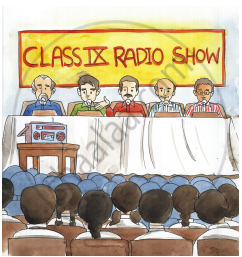
- News stories: about people in your class, about school, about sports (school and local), about the local community
- Comedy: jokes, short plays
- Interviews: with teachers, with exstudents of your school, with a Class IX student who has recently done something very interesting
- Games: general knowledge quiz, panel game, word game
- Advertisements: for shops/industries in the local community, things ‘for sale’ and ‘wanted’ by students
- Local sites: monuments/sites of historical importance and of tourist interest
- Special reports: e.g. safety at school, examination results, school uniform, school assemblies
- Interesting people: role-play interviews with film stars, sports personalities, TV personalities, etc.
- Entertainment reviews: music, films, videos, books, etc.
- Plays
- Songs with lyrics
- Speeches on important personalities
- Tele conference video conference with students, teachers, experts
Know all about Chess . Read and enjoy :
You now know a little about Koneru Humpychess player but do you know how to play chess? Let's know more about it:
Have you ever played chess? Did you know that chess is the oldest skill game in the world? But chess is more than just a. game of skill. It can tell you much about the way people lived in medieval times. If you look at the way a chess board is set up, then study the pieces and how they are used, you will realise that chess is a history of medieval times in miniature. The six different chess pieces on the board represent a cross section of medieval life with its many ceremonies grandeur ,and wars .
Chess was played many centuries ago in China, India, and Persia. No one really knows for sure in which country it originated. Then, in the eighth century, armies of Arabs known as Moors invaded Persia. The Moors learned chess from the Persians. When the Moors later invaded Spain, the soldiers brought the game of chess with them. Soon the Spanish were playing chess, too. From Spain, the popularity of chess quickly spread throughout all of Europe
Europeans gave chess pieces the names we know today; they probably had trouble pronouncing and spelling the Persian names, so they modernized them to reflect the way they lived. Today, the names certainly aren't modem but a thousand years ago they represented the very way in which both ordinary people and persons of rank lived their lives.
The pawns on the chess board represent serfs, or labourers. There are more of them than any other piece on the board, and often they are sacrificed to save the more valuable pieces. In medieval times, serfs were considered no more than the property of landowners, or chattels. Life was brutally hard for serfs during this era of history. They worked hard and died young. They were often left unprotected while wars raged around them. They could be traded, used as a diversion, or even sacrificed to allow the landowners to escape harm.
The castle piece on a chess board is the home, or the refuge, just as it was a home in medieval times. In Chess, each side has two castles, or rooks, as they are sometimes called.
The knight on a chess board represents the professional soldier of medieval times whose job it was to protect persons of rank, and there are two of them per side in a game of chess. Knights in a game of chess are more important than pawns, but less important than bishops, kings, or queens. Their purpose in the game of chess is to protect the more important pieces, and they can be sacrificed to save those pieces just as pawns can.
There is a bishop in the game of chess, who represents the church. The Church was a rich and mighty force in medieval times, and religion played a large part in every person's life. It is no wonder that a figure that represented the concept of religion found its way into the game. A bishop was the name for a priest in the Catholic church who had risen through the ranks to a more powerful position. In the game of chess, there are two bishops for each side.
The queen is the only piece on the board during a chess game that represents a woman, and she is the most powerful piece of the game.
The king is the tallest piece on the board, and is as well defended on the chessboard as in medieval life. In medieval times, the surrender of the king would mean the loss of the kingdom to invading armies and that could mean change for the worse. It was to everyone's advantage, from the lowest serf to the highest-ranking official, to keep the king safe from harm.. The king is the most important, but not the most powerful piece in chess. If you do not protect your king, you lose the game.
The next time you set up your chessboard and get ready 7 to play a friendly game or two, think of chess as a 6 history lesson. The pieces on the board represent a way 5 of life that is no more, and the real life dramas that occurred in medieval times are now only a game.
Such wondrous, fine, fantastic tales
Of dragons, gypsies, queens, and whales
And treasure isles, and distant shores
Where smugglers rowed with muffled oars,
And pirates wearing purple pants,
And sailing ships and elephants,
And cannibals crouching 'round the pot,
Stirring away at something hot.
(It smells so good , what can it be?
Good gracious, it's Penelope.)
The younger ones had Beatrix Potter
With Mr.Tod,the dirty rotter,
And Squirrel Nutkin,Pigling Bland,
And Mrs.Tiggy-Winkle and-
Just How The Camel Got His Hump,
And How the Monkey Lost His Rump,
And Mr. Toad, and bless my soul,
There's Mr.Rat and Mr. Mole-
Oh, books, what books they used to know,
Those children living long ago!
Read the lines given above and answer the question given below.
Explain with reference to context.
“If you are rested I would go,” I urged. “Get up and try to walk now.”
“Thank you,” he said and got to his feet, swayed from side to side and then sat down backwards in the dust.
“I was taking care of animals,” he said dully, but no longer to me. “I was only taking care of animals.”
There was nothing to do about him. It was Easter Sunday and the Fascists were advancing toward the Ebro. It was a grey overcast day with a low ceiling so their planes were not up. That and the fact that cats know how to look after themselves was all the good luck that the old man would ever have.
Read the extract given below and answer the question that follow.
What is the theme of the story?
She again rubbed a match on the wall, and the light shone round her; in the brightness stood her old grandmother, clear and shining, yet mild and loving in her appearance. “Grandmother,” cried the little one, “O take me with you; I know you will go away when the match burns out; you will vanish like the warm stove, the roast goose, and the large, glorious Christmas-tree.” And she made haste to light the whole bundle of matches, for she wished to keep her grandmother there. And the matches glowed with a light that was brighter than the noon-day, and her grandmother had never appeared so large or so beautiful. She took the little girl in her arms, and they both flew upwards in brightness and joy far above the earth, where there was neither cold nor hunger nor pain, for they were with God.
In the dawn of morning there lay the poor little one, with pale cheeks and smiling mouth, leaning against the wall; she had been frozen to death on the last evening of the year; and the New-year’s sun rose and shone upon a little corpse! The child still sat, in the stiffness of death, holding the matches in her hand, one bundle of which was burnt. “She tried to warm herself,” said some. No one imagined what beautiful things she had seen, nor into what glory she had entered with her grandmother, on New-year’s day.
Read the extract given below and answer the question that follow.
What happened when she lighted another match?
Beside him in the shoals as he lay waiting glimmered a blue gem. It was not a gem, though: it was sand—?worn glass that had been rolling about in the river for a long time. By chance, it was perforated right through—the neck of a bottle perhaps?—a blue bead. In the shrill noisy village above the ford, out of a mud house the same colour as the ground came a little girl, a thin starveling child dressed in an earth—?coloured rag. She had torn the rag in two to make skirt and sari. Sibia was eating the last of her meal, chupatti wrapped round a smear of green chilli and rancid butter; and she divided this also, to make
it seem more, and bit it, showing straight white teeth. With her ebony hair and great eyes, and her skin of oiled brown cream, she was a happy immature child—?woman about twelve years old. Bare foot, of course, and often goosey—?cold on a winter morning, and born to toil. In all her life, she had never owned anything but a rag. She had never owned even one anna—not a pice.
Why does the writer mention the blue bead at the same time that the crocodile is introduced?
Ans. The author mentions the blue bead at the same time that the crocodile is introduced to create suspense and a foreshadowing of the events’to happen.
Read the extract given below and answer the question that follow.
Describe Sibia.
What did Mr Nath thought Nishad had come to his place the second time for?
What happens to our body when we sleep?
How did Vijay Singh use the egg? How did he use the lump of salt?
The last two lines of the poem are not prohibitions or instructions. What is the adult now asking the child to do? Do you think the poet is suggesting that this is unreasonable? Why?
Bring out some of the sterling qualities of the character of Taro.
Or
Give a character sketch of Taro.
Complete the following sentence.
The young boy spent his afternoons in the tree ________.
Answer the following question.
What was the purpose of these special days?
Multiple Choice Question:
What does the word “marvellous’ mean?
Multiple Choice Question:
What does the poem reveal about the speaker?
What does the rebel do?
