Advertisements
Advertisements
प्रश्न
Given below is a highly simplified diagram of the human kidney cut open longitudinally. Answer the question that follow:
Why does the cortex of the kidney show a dotted appearance?

Advertisements
उत्तर
As the cortex region contains numerous nephrons or kidney tubules, therefore, it shows a dotted appearance.
संबंधित प्रश्न
Draw the well-labelled diagram of the human excretory system
Name an animal which absorbs oxygen through its moist skin.
Describe the mechanism of urine formation in human excretory system. Draw a labelled diagram to illustrate your answer.
State if the following statement is true or false. Correct the statement if it is false.
Liver produces bile pigments from the hemoglobin of broken RBCs.
Correct and rewrite the statement by changing the biological term that is underlined for the statement:
The kidney is composed of number of neurons.
Given below is a simple diagram of the human kidney cut open longitudinally. Answer the following questions: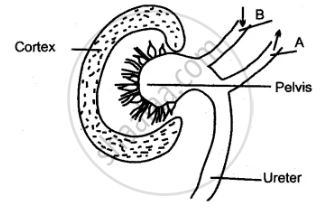
c
(v) Write two differences in the composition of the blood flowing through blood vessels A and B.
Complete the following sentence with appropriate word:
______ supplies blood to kidney.
Choose the correct option.
The part of nephron which absorbs glucose and amino acid is ______.
Explain the importance of soil for plant growth.
Give two examples of the following:
Nitrogenous waste
