Advertisements
Advertisements
प्रश्न
Give two suitable examples of vegetative propagation.
Advertisements
उत्तर
1. Eyes of potato:
The surface of a potato has several buds called eyes. Each of these buds when buried in soil develops into a new plant, which is identical to the parent plant.

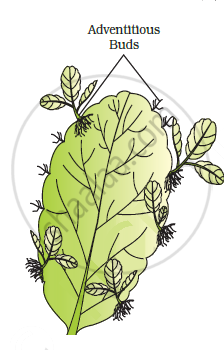
2. Leaf buds of Bryophyllum:
The leaves of Bryophyllum plants bear several adventitious buds on their margins. These leaf buds have the ability to grow and develop into tiny plants when the leaves get detached from the plant and come in contact with moist soil.
संबंधित प्रश्न
Write the name of the organism that is referred to as the ‘Terror of Bengal’.
Why do algae and fungi shift to sexual mode of reproduction just before the onset of adverse conditions?
Name the vegetative propagule in the following:
Agave
What is reproduction?
Vegetative propagation in Pistia occurs by ______.
Offspring formed by sexual reproduction exhibit more variation than those formed by Asexual reproduction because ______.
A population of genetically identical individuals, obtained from asexual reproduction is ______.
In ginger vegetative propagation occurs through ______.
Although potato tuber is an underground plant part, it is considered as a stem. Give two reasons.
Draw the sketches of a zoospore and a conidium. Mention two dissimilarities between them and atleast one feature common to both structures.
