Advertisements
Advertisements
प्रश्न
Give two suitable examples of vegetative propagation.
Advertisements
उत्तर
1. Eyes of potato:
The surface of a potato has several buds called eyes. Each of these buds when buried in soil develops into a new plant, which is identical to the parent plant.

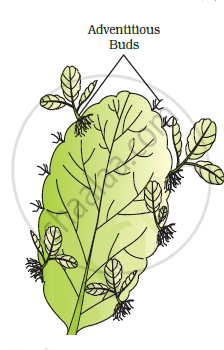
2. Leaf buds of Bryophyllum:
The leaves of Bryophyllum plants bear several adventitious buds on their margins. These leaf buds have the ability to grow and develop into tiny plants when the leaves get detached from the plant and come in contact with moist soil.
संबंधित प्रश्न
State two advantages of vegetative propagation.
Consider the following statement(s)
- In Protandrous flowers, pistil matures earlier
- In Protogynous flowers, pistil matures earlier
- Herkogamy is noticed in unisexual flowers
- Distyle is present in Primula
Fleshy buds produced in the axil of leaves, which grow to form new plants when shed and fall on the ground are called ______.
Offspring formed by sexual reproduction exhibit more variation than those formed by Asexual reproduction because ______.
The term ‘clone’ cannot be applied to offspring formed by sexual reproduction because ______.
A population of genetically identical individuals, obtained from asexual reproduction is ______.
In which one pair both the plants can be vegetatively propagated by leaf pieces?
What is common between vegetative reproduction and apomixis?
During free cell formation:
Match the organisms given in Column-’A’ with the vegetative propagules given in column ‘B’.
| Col. A | Col. B | ||
| i. | Bryophyllum | a) | offset |
| ii. | Agave | b) | eyes |
| iii. | Potato | c) | leaf buds |
| iv. | Water hyacinth | d) | bulbils |
