Advertisements
Advertisements
प्रश्न
Give scientific reason.
Older women are more likely to give birth to children with some abnormalities.
Advertisements
उत्तर
- A female has millions of oocytes at the time of birth and new ova are not formed thereafter.
- Menopause occurs at approximately 40-50 years of age and hence fewer numbers of eggs are present with reduced fertility since the oocytes have aged.
- Their ability to divide diminishes and they may not be able to complete meiotic division properly.
- Fertilization of such oocytes may result in the production of genetic abnormalities (like Down syndrome) in offspring.
Hence, older women are more likely to give birth to children with some abnormalities.
APPEARS IN
संबंधित प्रश्न
Women are often blamed for producing female children. Consequently, they are ill-treated and ostracized. How will you address this issue scientifically if you were to conduct an awareness programme to highlight the values involved?
Male and female gametes are ______.
Draw a labelled diagram of sperm.
Multiple choice question.
The given figure shows human sperm. Various parts of it are labelled as A, B, C, and D. Which labelled part represents acrosome?
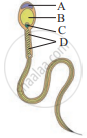
In angiosperms, the pollen germinates to produce a pollen tube that carries two gametes. What is the purpose of carrying two gametes when a single gamete can fertilize the egg?
The process which the sperm undergoes before penetrating the ovum is ____________.
Define gametogenesis.
Identify the given image and label its parts marked as a, b, c and d
The secondary oocyte enter into the fallopian tube through the ______.
Identify the longest period of menstrual cycle.
______ undergoes 2nd meiotic division during spermatogenesis.
Identify the wrong statement from the following.
The process of release of spermatozoa from Sertoli cells into cavity of the seminiferous tubules is called ______.
At what stage of life is oogenesis initiated in a human female?
Layers of an ovum from outside to inside is ______.
Read the following and answer from given below:
Oogenesis is the process of the formation of an ovum in the ovaries. It consists of three phases: multiplication, growth, and maturation. Oogenesis is controlled by hormones GnRH, LH, FSH. GnRH secreted by the hypothalamus stimulates the anterior lobe of the pituitary gland to secrete LH and FSH.
Which cell division is involved in the formation of secondary oocytes?
Process of maturation and development of sperms ______.
Select a correct pair of cells with identical set of chromosomes.
At the onset of puberty, gonadotropin releasing hormone is secreted by ______.
In which structures does spermatogenesis occur?
