Advertisements
Advertisements
प्रश्न
Give reason:
Reactions involving Grignard reagent must be carried out under anhydrous condition.
Advertisements
उत्तर
Grignard reagents are highly reactive compounds. They react with water or compounds containing hydrogen attached to the electronegative element. Hence, reactions involving the Grignard reagent must be carried out under anhydrous condition.
संबंधित प्रश्न
Explain reactions of haloarenes with sodium metal.
Which one of the following is an organometallic compound?
The reaction in which 2 molecules of chlorobenzene reacts with metallic sodium in presence of dry ether forming diphenyl is an example of ______.
How many gram of sodium (atomic mass 23 u) is required to prepare one mole of ethane from methyl chloride by Wurtz reaction?
Identify the compound that gives 2, 5-dimethylhexane by reacting with sodium metal in presence of dry ether.
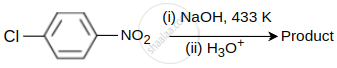
Identify the product of the following reaction.
\[\ce{CH3 - Br + C2H5COOAg ->[\Delta] ?}\]
What is the action of following on ethyl bromide:
Na in dry ether
Write chemical reactions for the following conversions:
Bromobenzene to toluene.
The molecular formula of Wilkinson's catalyst used in the hydrogenation of alkenes is ______.
The Wurtz-Fittig reaction involves condensation of ______.
Which of the following is called Wilkinson's catalyst?
Identify the product obtained in the following reaction.
Which of the following alkyl halide is treated with sodium metal to obtain 2, 2, 3, 3 tetramethyl butane?
Write the chemical reaction for the following:
Chlorobenzene is heated with fuming H2SO4.
Write the structure of the product formed when chlorobenzene is treated with sodium metal in the presence of dry ether.
Write a note on Wurtz Reaction.
Write the product formed during Chlorobenzene treated with chlorine reactions.
Write the product formed by chlorobenzene treated with a fuming H2SO4 reaction.
Write the product in the following reaction:
Chlorobenzene reacts with sodium metal in presence of dry ether.
What is the action of following on ethyl bromide?
silver nitrite
Identify the product 'Z' in the following series of reactions.
\[\ce{\underset{}{Ethanol} ->[SOCl2][Δ] \underset{\underset{}{}}{X}->[Mg][Dry ether] \underset{\underset{}{}}{Y}->[NH3] \underset{\underset{}{}}{Z}}\]
Chlorobenzene reacts with Mg in dry ether to give a compound (A), which further reacts with ethanol to yield.
Which from following compounds is NOT obtained when ethyl chloride reacts with isopropyl chloride in presence of Na and dry ether?
Identify the CORRECT stability order of alkyl substituted alkenes from following.
