Advertisements
Advertisements
प्रश्न
Give the formulae of the chlorides of the elements X and Y having atomic numbers of 3 and 6 respectively. Will the properties of the two chlorides be similar or different? Explain your answer.
Advertisements
उत्तर
The formula of the chloride of element X is XCl (or X+Cl-). Element X has an electronic configuration of 2,1. When it reacts with chlorine with electronic configuration 2,8,7, it transfers one electron to chlorine atom to form an ionic chloride compound.
The formula of the chloride of element Y is YCl4. Element Y has an electronic configuration of 2,4. When it reacts with chlorine with electronic configuration 2,8,7, it shares its four electrons with four chlorine atoms.
Properties of the two chlorides will be different because of the difference in the natures of bonding between them. For example, XCl, being ionic in nature, must have high melting and boiling points but YCl4, being covalent in nature, must have low melting and boiling points.
APPEARS IN
संबंधित प्रश्न
Name the type of bonds formed in ionic compounds and in the compounds formed by carbon.
State the reason to explain why covalent compounds "are bad conductors of electricity".
Choose the correct answer from the options given below:
Which of the following is a common characteristic of a covalent compound?
1) high melting point
2) consists of molecules
3) always soluble in water
4) Conducts electricity when it is in the molten state
Why does carbon form compounds mainly by covalent bonding?
Draw the electron-dot structure of HCl compound and state the type of bonding.
What is graphite?
One of the following is not an allotrope of carbon. This is:
(a) diamond
(b) graphite
(c) cumene
(d) buckministerfullerene
You can buy solid air-freshners in shops. Do you think these substance are ionic or covalent? Why?
State the type of bonding in the following molecule.
Ammonium ion
Define a coordinate bond.
Give two example in following case:
Gaseous non polar compounds
Observe the straight chain hydrocarbons given below and answer the following
questions :
i) Which of the straight chain compounds from A and B is saturated and unsaturated straight chains?
ii) Name these straight chains.
iii) Write their chemical formulae and number of – CH2 - units.
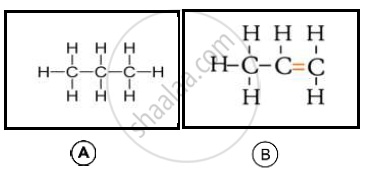
The carbon compound is used in daily life is ______.
Give examples for the following:
Two gaseous non polar compounds.
What is the term defined below?
A bond formed by a shared pair of electrons, each bonding atom contributing one electron to the pair.
The following table shows the electronic configuration of the elements W, X, Y, Z:
|
Element |
W |
X |
Y |
Z |
|
Electronic |
2,8,1 |
2,8,7 |
2,5 |
1 |
Answer the following questions based on the table above:
What type of bond is formed between Y and Z.
Element A has 2 electrons in its M shell. Element B has atomic number 7.
If the compound formed between A and B is melted and an electric current is passed through the molten compound, the element A will be obtained at the ______ and B at the ______ of the electrolytic cell.
What is a covalent bond?
It is observed that covalent compounds are had conductors of electricity. Give reason.
