Advertisements
Advertisements
प्रश्न
Give a reason for the following:
Cu+2 salts are paramagnetic, while Cu+ salts are diamagnetic.
Cu(II) is paramagnetic but Cu(I) is diamagnetic. Give reason (At. no. of Cu = 29).
Advertisements
उत्तर १
The electronic configurations of Cu2+ and Cu+ are [Ar] 3d9 4s0 and [Ar] 3d10 4s0, respectively. Cu2+ has one unpaired electron, making it paramagnetic, whereas Cu+ has no unpaired electrons, making it diamagnetic.
उत्तर २
- Atomic number of Cu = 29, electronic configuration is [Ar] 3d10 4s1.
- Cu(I) ion has oxidation state +1, so it loses one 4s electron. Its configuration becomes 3d10 (fully filled d-orbitals).
- Since all electrons in Cu(I) are paired in the 3d10 configuration, the Cu(I) ion is diamagnetic (no unpaired electrons).
- Cu(II) ion has oxidation state +2, so it loses one 4s electron and one 3d electron. Configuration becomes 3d9.
- With one unpaired electron in the 3d9 configuration, the Cu(II) ion is paramagnetic (has unpaired electrons).
Therefore, Cu(II) ion is paramagnetic due to the presence of one unpaired electron, while Cu(I) is diamagnetic because all electrons are paired.
Notes
Students can refer to the provided solutions based on their preferred marks.
संबंधित प्रश्न
What is ferromagnetism?
What type of magnetism is shown in the following alignment of magnetic moments?

Explain the following with suitable examples:
Ferrimagnetism
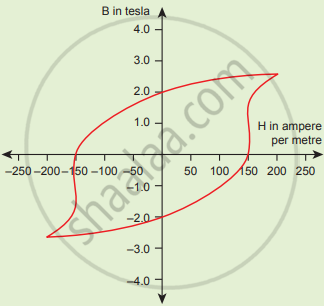
The BH curve for a ferromagnetic material is shown in the figure. The material is placed inside a long solenoid which contains 1000 turns/cm. The current that should be passed in the solenonid to demagnetize the ferromagnet completely is
Fe3O4 (magnetite) is an example of ___________.
The value of magnetic moment is zero in the case of antiferromagnetic substances because the domains:
(i) get oriented in the direction of the applied magnetic field.
(ii) get oriented opposite to the direction of the applied magnetic field.
(iii) are oppositely oriented with respect to each other without the application of magnetic field.
(iv) cancel out each other’s magnetic moment.
Which one of the following would feel attraction when placed in magnetic field: Co2+, Ag+, Ti4+, Zn2+
The susceptibility of a paramagnetic material is 99. The permeability of the material in Wb/A-m is ______.
[permeability of the free space μ0 = 4π × 10-7 Wb/A - m]
Among the following ions, which one has the highest paramagnetism?
Which of the following is not paramagnetic?
