Advertisements
Advertisements
प्रश्न
Frame sentences using the homograph to show the difference in their meanings:
Train
Advertisements
उत्तर
- As a noun: We missed our train because of the heavy traffic on the way to the station.
- As a verb: Athletes must train hard every day if they want to represent their country in the Olympics.
APPEARS IN
संबंधित प्रश्न
Form
• Have/has+ past participle
• Have/ has+ been + past participle
Work individually
Complete the following sentences by using the present perfect form (as
given in C.l)ofthe given verbs.
a) The kids (work) really hard for the show. Now, don't cancel it, please.
b) Yippyl I (select) for the interschool dance competition!
c) I ... (contest) five elections so far.
d) John? 0, he is a delightful boy. I (know) him since his childhood.
e) ... you ever (be) to the Taj Mahal?
• The box below shows different uses or meanings of the present perfect. Match the sentences above with the uses or meanings of the present perfect they illustrate.
i) Something that has happened several times up to the present.
ii) Announcement or news of a recent event.
iii) Finished event connected with the present.
iv) An action or situation that has continued up to the present.
v} Finished event at some/ any time up to now.
Answer: i - c; ii - b; iii - a; iv - d; v - e
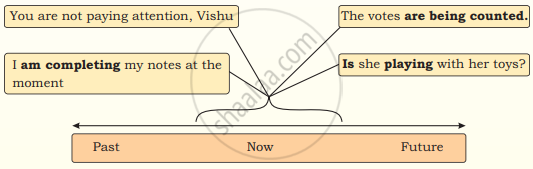
- S + is/am/are + verb + ing
- S + is/am/are + not + verb + ing.
- Is/am/are + S + verb + ing?
- S + is/am/are + being + Verb (past participle)
Verbs that are normally NOT used in the progressive form.
1. Which sentence in each of the following pairs is acceptable and
why?
1. a. I am respecting you.
b. I respect you.
2. a. My son loves to draw and paint.
b. My son is loving to draw and paint.
3. a. We are having two cars.
b. We have two cars.
4. a. I am thinking you are new to this place.
b. I think you are new to this place.
5. a. The cake smells good.
b. The cake is smelling good.
| Verbs referring to mental states (eg. know, think, believe etc) and to the use of the senses (eg. smell, taste etc) are never, or hardly ever, used in progressive forms. Some of these verbs are: believe prefer know suppose feel sound (dis)like love realise understand hear taste see hate recognise want see belong doubt imagme remember wish smell agree possess own owe involve include depend |
Can you explain the difference between?
1. a. l justcan'timaginehowyougotintosuchamess.
b. You're imagining things nothing will happen.
2. a. The coffee tastes bitter
b. Mother is tasting coffee to check ifit is too bitter.
3. a. My teacher admires my art work
b. She is admiring the latest painting I have made.
4. a. The doctor is feeling the patient's pulse.
b. The patient is feeling better.
Find the incorrect sentences and then rewrite them correctly. Put a tick mark (✓)against the sentences that you think are correct.
1) By 2005, the singer recorded ten albums.
2) When I got to the bank, it had closed.
3) Timothy, the tiger, had killed five calves yesterday.
4) When Rehman met Mini ten years later, she grew up into a young girl.
5) By the time we reached the airport, the flight had left.
6) We hardly went a kilometre or so when the car broke down.
Work with apartner
In the following sentences, choose and circle the verb form you think best fits the meaning of each sentence. You have been provided an example.
| 1. Tomorrow | is will be is going to be | Wednesday. |
| 2. The train | has left will have left is going to leave | by the time you reach the station. |
| 3. Hurry! The film | does will is about to | start. |
| 4. The Minister | opens is opening is about to open | the new Art Centrenext week. |
| 5. This time next year, he | will live is living will be living | in Mumbai. |
| 6. I | am going to be will be will have been | a nurse when I grow up |
Name the Tense of the Verb underlined to include Time (Past/Present/Future) and Aspect (Simple/Continuous/Perfect/Perfect Continuous).
We were designing the first Macintosh computer.
Present Participle: The form of a verb, ending in ‘ing’, which is used in forming continuous tenses. For example, He is sitting here.
Present participle can also be used as an adjective. For example, He uses a walking stick.
Now, find out the ‘ing’ forms from the story and classify them into the following table.
| Present Participle used as an Adjective | Present Participle used as a Verb in the Continuous Tense |
| twinkling eyes | was oozing |
| 1. | |
| 2. | |
| 3. | |
| 4. |
Read the following sentence carefully, underline the verb and find out the tense in the sentence.
Still they took no notice of him.
Read the following sentence carefully, underline the verb and find out the tense in the sentence.
He just felt dizzy.
Rewrite the sentence in simple future tense.
He has been playing since afternoon.
