Advertisements
Advertisements
प्रश्न
Four identical hollow cylindrical columns of mild steel support a big structure of mass 50,000 kg. The inner and outer radii of each column are 30 cm and 60 cm respectively. Assuming the load distribution to be uniform, calculate the compressional strain of each column.
Advertisements
उत्तर १
Mass of the big structure, M = 50,000 kg
Inner radius of the column, r = 30 cm = 0.3 m
Outer radius of the column, R = 60 cm = 0.6 m
Young’s modulus of steel, Y = 2 × 10¹¹ Pa
Total force exerted, F = Mg = 50000 × 9.8 N
Stress = Force exerted on a single column = `(50000 xx 9.8)/4 = 122500 N`
Young’s modulus, Y = Stress/Strain
Strain = `(F/A)/Y`
Where
Area, `A =pi(R^2 - r^2) = pi((0.6)^2 - (0.3)^2)`
`"Strain" = 122500/(pi[(0.6)^2 - (0.3)^2]xx2xx10^11) = 7.22 xx10^(-7)`
Hence, the compressional strain of each column is 7.22 × 10⁻⁷.
उत्तर २
Here total mass to be supported, M = 50,000 kg
∴ Total weight of the structure to be supported = Mg
= 50000 x 9.8 N
Since the weight is to be supported by 4 columns
∴Compressional force on each column (F) is given by
`F = "Mg"/4 = (50000xx9.8)/4 N`
Inner radius of columns, `r_1 = 30 cm = 0.3 m`
Outer radius of column, r_2 = 60 cm = 0.6 m
∴ Area of cross- section of each column is given by
`A = pi(r_2^2 - r_1^2)`
`=pi[(0.6)^2 - (0.3)^2] = 0.27 pi m^2`
Young's Modulus, `Y = 2 xx 10^11` Pa
Compressional strain of each column = ?
∴`Y = "Compressional force/area"/"Compressional Strain"`
`= "F/A"/"Compressional Strain"`
or Compressional strain of each column
`= F/(AY)= (50000xx9.8xx7)/(4xx0.27xx22xx2xx10^11)`
`= 0.722 xx 10^(6)`
∴ Compressional strain of all columns is given by
`= 0.722 xx 10^(-6) xx 4 = 2.88 xx 10^(-6)`
`= 2.88 xx 10^(-6)`
APPEARS IN
संबंधित प्रश्न
A steel wire of length 4.7 m and cross-sectional area 3.0 × 10⁻⁵ m2 stretches by the same amount as a copper wire of length 3.5 m and cross-sectional area of 4.0 × 10⁻⁵ m2 under a given load. What is the ratio of Young’s modulus of steel to that of copper?
The stress-strain graphs for materials A and B are shown in Figure
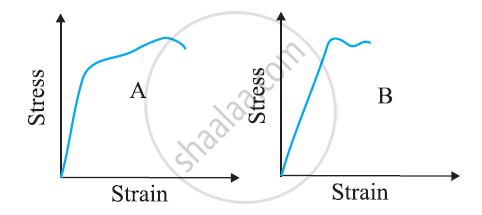
The graphs are drawn to the same scale.
(a) Which of the materials has the greater Young’s modulus?
(b) Which of the two is the stronger material?
Two wires A and B are made of same material. The wire A has a length l and diameter rwhile the wire B has a length 2l and diameter r/2. If the two wires are stretched by the same force, the elongation in A divided by the elongation in B is
A wire elongates by 1.0 mm when a load W is hung from it. If this wire goes over a a pulley and two weights W each are hung at the two ends, he elongation of he wire will be
The length of a metal wire is l1 when the tension in it T1 and is l2 when the tension is T2. The natural length of the wire is
A student plots a graph from his reading on the determination of Young modulus of a metal wire but forgets to put the labels. the quantities on X and Y-axes may be respectively
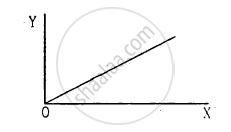
(a) weight hung and length increased
(b) stress applied and length increased
(c) stress applied and strain developed
(d) length increased and the weight hung.
A uniform rectangular block of mass of 50 kg is hung horizontally with the help of three wires A, B and C each of length and area of 2m and 10mm2 respectively as shown in the figure. The central wire is passing through the centre of gravity and is made of material of Young's modulus 7.5 x 10¹⁰ Nm−2 and the other two wires A and C symmetrically placed on either side of the wire B are of Young's modulus 1011 Nm−2 The tension in the wires A and B will be in the ratio of:

The temperature of a wire is doubled. The Young’s modulus of elasticity ______.
The temperature of a wire is doubled. The Young’s modulus of elasticity ______.
A rigid bar of mass M is supported symmetrically by three wires each of length l. Those at each end are of copper and the middle one is of iron. The ratio of their diameters, if each is to have the same tension, is equal to ______.
The Young’s modulus for steel is much more than that for rubber. For the same longitudinal strain, which one will have greater tensile stress?
Identical springs of steel and copper are equally stretched. On which, more work will have to be done?
A steel wire of mass µ per unit length with a circular cross section has a radius of 0.1 cm. The wire is of length 10 m when measured lying horizontal, and hangs from a hook on the wall. A mass of 25 kg is hung from the free end of the wire. Assuming the wire to be uniform and lateral strains << longitudinal strains, find the extension in the length of the wire. The density of steel is 7860 kg m–3 (Young’s modules Y = 2 × 10¹¹ Nm–2).
In nature, the failure of structural members usually result from large torque because of twisting or bending rather than due to tensile or compressive strains. This process of structural breakdown is called buckling and in cases of tall cylindrical structures like trees, the torque is caused by its own weight bending the structure. Thus the vertical through the centre of gravity does not fall within the base. The elastic torque caused because of this bending about the central axis of the tree is given by `(Ypir^4)/(4R) . Y` is the Young’s modulus, r is the radius of the trunk and R is the radius of curvature of the bent surface along the height of the tree containing the centre of gravity (the neutral surface). Estimate the critical height of a tree for a given radius of the trunk.
A metal wire of length L, area of cross section A and Young's modulus Y behaves as a spring of spring constant k given by:
What does the dimensional formula [L⁻¹M¹T⁻²] represent?
What is longitudinal strain?
In the formula Y = MgL/(πr²l), what does 'l' represent?
The maximum elongation of a steel wire of 1 m length if the elastic limit of steel and its Young’s modulus, respectively, are 8 × 10⁸ Nm−2 and 2 × 10¹¹ Nm−2, is ______.
