Advertisements
Advertisements
प्रश्न
For a non-zero rational number z, (z–2)3 is equal to ______.
पर्याय
z6
z–6
z1
z4
Advertisements
उत्तर
For a non-zero rational number z, (z–2)3 is equal to z–6.
Explanation:
Using law of exponents,
(am)n = (a)mn ...[∵ a is non-zero integer]
Similarly, (z–2)3 = (z)(–2) × 3 = (z)–6
APPEARS IN
संबंधित प्रश्न
`(3/4)^5 ÷ (5/3)^5` is equal to ______.
`[(2/13)^-6 ÷ (2/13)^3]^3 xx (2/13)^-9` = ______.
By solving (60 – 70) × (60 + 70) we get ______.
329.25 = 3 × 10² + 2 × 101 + 9 × 100 + 2 × 10⁻¹ + 5 × 10⁻²
Find the value of x so that `(5/3)^-2 xx (5/3)^-14 = (5/3)^(8x)`
Find the value of x–3 if x = (100)1 – 4 ÷ (100)0.
Find the value of n.
`6^n/6^-2 = 6^3`
Fill in the blanks

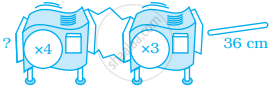
For hook-up, determine whether there is a single repeater machine that will do the same work. If so, describe or draw it.

Supply the missing information for diagram.