Advertisements
Advertisements
प्रश्न
Following data are obtained for reaction :
N2O5 → 2NO2 + 1/2O2
| t/s | 0 | 300 | 600 |
| [N2O5]/mol L–1 | 1.6 × 10⁻² | 0.8 × 10⁻² | 0.4 × 10⁻² |
1) Show that it follows first order reaction.
2) Calculate the half-life.
(Given log 2 = 0.3010, log 4 = 0.6021)
Advertisements
उत्तर
1) For 1st order reaction the integral rate law is :
kt = `ln a_0/a_t`
Given
a0 = 1.6×10⁻² mol L−1
For t = 300 s, at = 0.8×10⁻² mol L−1
For t = 600 s, at = 0.4×10⁻² mol L−1
Using first set of data in the rate law,
`k xx 300 = ln (1.6 xx 10^(-2))/(0.8xx 10^(-2))`
k = `0.00231 s^(-1)`
Using second set of data in the rate law,
`k xx 600 = ln (1.6 xx 10^(-2))/(0.4 xx 10^(-2))`
k = 0.00231 s-1
The value of k is consistent, therefore it follows first order reaction.
2) The half life of first order reaction is given by the following equation:
`t_(1/2) = (ln 2)/k = 2.303 xx (log 2)/k`
`:. t_(1/2) = 2.303 xx (log 2)/0.00231 = 300.08 s`
APPEARS IN
संबंधित प्रश्न
A first order reaction has a rate constant 1.15 × 10⁻³ s−1. How long will 5 g of this reactant take to reduce to 3 g?
In a pseudo first order reaction in water, the following results were obtained:
| t/s | 0 | 30 | 60 | 90 |
| [A]/mol L−1 | 0.55 | 0.31 | 0.17 | 0.085 |
Calculate the average rate of reaction between the time interval 30 to 60 seconds.
The time required for 10% completion of a first order reaction at 298 K is equal to that required for its 25% completion at 308 K. If the value of A is 4 × 10¹⁰ s−1. Calculate k at 318 K and Ea.
First order reaction is 50% complete in 1.26 × 10¹⁴s. How much time could it take for 100% completion?
In the first order reaction, half of the reaction is complete in 100 seconds. The time for 99% of the reaction to occurs will be
In a first order reaction the concentration of reactants decreases from 400mol L-1 to 25 mol L-1 in 200 seconds. The rate constant for the reaction is ______.
Observe the graph shown in figure and answer the following questions:
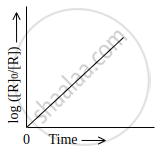
- What is the order of the reaction?
- What is the slope of the curve?
- Write the relationship between k and t1/2 (half life period).
For a first order reaction, the ratio of the time for 75% completion of a reaction to the time for 50% completion is ______. (Integer answer)
Radioactive decay follows first-order kinetics. The initial amount of two radioactive elements X and Y is 1 gm each. What will be the ratio of X and Y after two days if their half-lives are 12 hours and 16 hours respectively?
How will you represent first order reactions graphically?
