Advertisements
Advertisements
प्रश्न
Find the vector equation of the plane passing through the points (1, 1, −1), (6, 4, −5) and (−4, −2, 3).
Advertisements
उत्तर
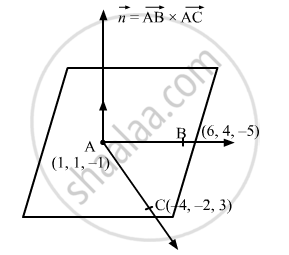
\[ \text{ Let } A(1, 1, -1),B(6, 4, -5) \text{ and } C(-4, -2, 3).\]
\[\text{ The required plane passes through the point } A(1, 1, -1) \text{ whose position vector is } \vec{a} = \hat{i} + \hat{j} - \hat{k} \text{ and is normal to the vector } \vec{n} \text{ given by } \]
\[ \vec{n} = \vec{AB} \times \vec{AC} \]
\[ \text{ Clearly } , \vec{AB} = \vec{OB} - \vec{OA} = \left( 6 \hat{i} + 4 \hat{j} - 5 \hat{k} \right) - \left( \hat{i} + \hat{j} - \hat{k} \right) = 5 \hat{i} + 3 \hat{j} - 4 \hat{k} \]
\[ \vec{AC} = \vec{OC} - \vec{OA} = \left( - 4 \hat{i} - 2 \hat{j} + 3 \hat{k} \right) - \left( \hat{i} + \hat{j} - \hat{k} \right) = - 5 \hat{i} - 3 \hat{j} + 4 \hat{k} \]
\[ \vec{n} = \vec{AB} \ × \vec{AC} = \begin{vmatrix}\hat{i} & \hat{j} & \hat{k} \\ 5 & 3 & - 4 \\ - 5 & - 3 & 4\end{vmatrix} = 0 \hat{i} + 0 \hat{j} + 0 \hat{k} = \vec{0} \]
\[\text{ So, the given points are collinear } .\]
\[\text{ Thus, there will be infinite number of planes passing through these points.} \]
\[\text{ Their equations (passing through (1, 1, -1) are given by } \]
\[a \left( x - 1 \right) + b \left( y - 1 \right) + c \left( z + 1 \right) = 0 . . . \left( 1 \right)\]
\[\text{ Since this passes through B }(6, 4, -5),\]
\[a \left( 6 - 1 \right) + b \left( 4 - 1 \right) + c \left( - 5 + 1 \right) = 0\]
\[ \Rightarrow 5a + 3b - 4c = 0 . . . \left( 2 \right)\]
\[ \text{ From (1) and (2), the equations of the infinite planes are } \]
\[a \left( x - 1 \right) + b \left( y - 1 \right) + c \left( z + 1 \right) = 0, \text{ where } 5a + 3b - 4c = 0 . \]
APPEARS IN
संबंधित प्रश्न
Find the equation of the plane passing through (a, b, c) and parallel to the plane `vecr.(hati + hatj + hatk) = 2`
Find the Cartesian form of the equation of a plane whose vector equation is
\[\vec{r} \cdot \left( - \hat{i} + \hat{j} + 2 \hat{k} \right) = 9\]
Find the vector equations of the coordinate planes.
\[\vec{n}\] is a vector of magnitude \[\sqrt{3}\] and is equally inclined to an acute angle with the coordinate axes. Find the vector and Cartesian forms of the equation of a plane which passes through (2, 1, −1) and is normal to \[\vec{n}\] .
Show that the normals to the following pairs of planes are perpendicular to each other.
x − y + z − 2 = 0 and 3x + 2y − z + 4 = 0
Find the vector equation of a plane which is at a distance of 5 units from the origin and which is normal to the vector \[\hat{i} - \text{2 } \hat{j} - \text{2 } \hat{k} .\]
Determine the value of λ for which the following planes are perpendicular to each other.
3x − 6y − 2z = 7 and 2x + y − λz = 5
Find the equation of a plane passing through the point (−1, −1, 2) and perpendicular to the planes 3x + 2y − 3z = 1 and 5x − 4y + z = 5.
Find the equation of the plane passing through (a, b, c) and parallel to the plane \[\vec{r} \cdot \left( \hat{i} + \hat{j} + \hat{k} \right) = 2 .\]
Find the vector equation of the line through the origin which is perpendicular to the plane \[\vec{r} \cdot \left( \hat{i} + 2 \hat{j} + 3 \hat{k} \right) = 3 .\]
Find the equation of the plane through (2, 3, −4) and (1, −1, 3) and parallel to x-axis.
Find the equation of the plane passing through the intersection of the planes x − 2y + z = 1 and 2x + y + z = 8 and parallel to the line with direction ratios proportional to 1, 2, 1. Also, find the perpendicular distance of (1, 1, 1) from this plane
Find the coordinates of the point where the line through (5, 1, 6) and (3, 4, 1) crosses the yz - plane .
Find the equation of a plane which passes through the point (3, 2, 0) and contains the line \[\frac{x - 3}{1} = \frac{y - 6}{5} = \frac{z - 4}{4}\] .
Find the coordinates of the foot of the perpendicular from the point (2, 3, 7) to the plane 3x − y − z = 7. Also, find the length of the perpendicular.
Find the length and the foot of perpendicular from the point \[\left( 1, \frac{3}{2}, 2 \right)\] to the plane \[2x - 2y + 4z + 5 = 0\] .
Write the equation of the plane parallel to the YOZ- plane and passing through (−4, 1, 0).
Write the value of k for which the planes x − 2y + kz = 4 and 2x + 5y − z = 9 are perpendicular.
Write the distance between the parallel planes 2x − y + 3z = 4 and 2x − y + 3z = 18.
Write the equation of the plane passing through (2, −1, 1) and parallel to the plane 3x + 2y −z = 7.
Write the position vector of the point where the line \[\vec{r} = \vec{a} + \lambda \vec{b}\] meets the plane \[\vec{r} . \vec{n} = 0 .\]
Write the equation of a plane which is at a distance of \[5\sqrt{3}\] units from origin and the normal to which is equally inclined to coordinate axes.
The vector equation of the plane containing the line \[\vec{r} = \left( - 2 \hat{i} - 3 \hat{j} + 4 \hat{k} \right) + \lambda\left( 3 \hat{i} - 2 \hat{j} - \hat{k} \right)\] and the point \[\hat{i} + 2 \hat{j} + 3 \hat{k} \] is
The equation of the plane parallel to the lines x − 1 = 2y − 5 = 2z and 3x = 4y − 11 = 3z − 4 and passing through the point (2, 3, 3) is
Find a vector of magnitude 26 units normal to the plane 12x − 3y + 4z = 1.
If the line drawn from (4, −1, 2) meets a plane at right angles at the point (−10, 5, 4), find the equation of the plane.
If O be the origin and the coordinates of P be (1, 2,−3), then find the equation of the plane passing through P and perpendicular to OP.
Find the value of λ for which the following lines are perpendicular to each other `("x"-5)/(5λ+2) = (2 -"y")/(5) = (1 -"z")/(-1); ("x")/(1) = ("y"+1/2)/(2λ) = ("z" -1)/(3)`
hence, find whether the lines intersect or not
The coordinates of the foot of the perpendicular drawn from the point (2, 5, 7) on the x-axis are given by ______.
The equation of a line, which is parallel to `2hat"i" + hat"j" + 3hat"k"` and which passes through the point (5, –2, 4), is `(x - 5)/2 = (y + 2)/(-1) = (z - 4)/3`.
The point at which the normal to the curve y = `"x" + 1/"x", "x" > 0` is perpendicular to the line 3x – 4y – 7 = 0 is:
Let A be the foot of the perpendicular from focus P of hyperbola `x^2/a^2 - y^2/b^2 = 1` on the line bx – ay = 0 and let C be the centre of hyperbola. Then the area of the rectangle whose sides are equal to that of PA and CA is,
The coordinates of the foot of the perpendicular drawn from the point A(1, 0, 3) to the join of the points B(4, 7, 1) and C(3, 5, 3) are
