हिंदी

Find the Vector Equation of the Plane Passing Through the Points (1, 1, −1), (6, 4, −5) and (−4, −2, 3). - Mathematics

Advertisements
Advertisements

प्रश्न

Find the vector equation of the plane passing through the points (1, 1, −1), (6, 4, −5) and (−4, −2, 3).

योग
Advertisements

उत्तर


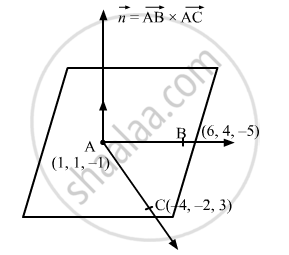
\[ \text{ Let } A(1, 1, -1),B(6, 4, -5) \text{ and } C(-4, -2, 3).\]
\[\text{ The required plane passes through the point } A(1, 1, -1)  \text{ whose position vector is  }  \vec{a} = \hat{i} + \hat{j}  - \hat{k}  \text{ and is normal to the vector }  \vec{n} \text{ given by } \]
\[ \vec{n} = \vec{AB} \times \vec{AC} \]
\[ \text{ Clearly } , \vec{AB} = \vec{OB} - \vec{OA} = \left( 6 \hat{i} + 4 \hat{j}  - 5 \hat{k}  \right) - \left( \hat{i}  + \hat{j}  - \hat{k}  \right) = 5 \hat{i}  + 3 \hat{j}  - 4 \hat{k} \]
\[ \vec{AC} = \vec{OC} - \vec{OA} = \left( - 4 \hat{i}  - 2 \hat{j}  + 3 \hat{k}  \right) - \left( \hat{i}  + \hat{j}  - \hat{k}  \right) = - 5 \hat{i}  - 3 \hat{j}  + 4 \hat{k}  \]
\[ \vec{n} = \vec{AB} \ × \vec{AC} = \begin{vmatrix}\hat{i} & \hat{j} & \hat{k}  \\ 5 & 3 & - 4 \\ - 5 & - 3 & 4\end{vmatrix} = 0 \hat{i}  + 0 \hat{j}  + 0 \hat{k}  = \vec{0} \]
\[\text{ So, the given points are collinear } .\]
\[\text{ Thus, there will be infinite number of planes passing through these points.} \]
\[\text{ Their equations (passing through (1, 1, -1) are given by } \]
\[a \left( x - 1 \right) + b \left( y - 1 \right) + c \left( z + 1 \right) = 0 . . . \left( 1 \right)\]
\[\text{ Since this passes through B }(6, 4, -5),\]
\[a \left( 6 - 1 \right) + b \left( 4 - 1 \right) + c \left( - 5 + 1 \right) = 0\]
\[ \Rightarrow 5a + 3b - 4c = 0 . . . \left( 2 \right)\]
\[ \text{ From (1) and (2), the equations of the infinite planes are } \]
\[a \left( x - 1 \right) + b \left( y - 1 \right) + c \left( z + 1 \right) = 0, \text{ where } 5a + 3b - 4c = 0 . \]


shaalaa.com
  क्या इस प्रश्न या उत्तर में कोई त्रुटि है?
अध्याय 29: The Plane - Exercise 29.05 [पृष्ठ २३]

APPEARS IN

आरडी शर्मा Mathematics [English] Class 12
अध्याय 29 The Plane
Exercise 29.05 | Q 4 | पृष्ठ २३

वीडियो ट्यूटोरियलVIEW ALL [1]

संबंधित प्रश्न

Find the vector equation of a plane which is at a distance of 7 units from the origin and normal to the vector.`3hati + 5hatj - 6hatk`


If O be the origin and the coordinates of P be (1, 2, −3), then find the equation of the plane passing through P and perpendicular to OP.


Find the Cartesian form of the equation of a plane whose vector equation is 

 \[\vec{r} \cdot \left( 12 \hat{i} - 3 \hat{j} + 4 \hat{k} \right) + 5 = 0\]


Find the Cartesian form of the equation of a plane whose vector equation is 

  \[\vec{r} \cdot \left( - \hat{i} + \hat{j}  + 2 \hat{k} \right) = 9\]


Find the vector and Cartesian equations of a plane passing through the point (1, −1, 1) and normal to the line joining the points (1, 2, 5) and (−1, 3, 1).


Show that the normals to the following pairs of planes are perpendicular to each other.

\[\vec{r} \cdot \left( 2 \hat{i}  - \hat{j}  + 3 \hat{k}  \right) = 5 \text{ and }  \vec{r} \cdot \left( 2 \hat{i}  - 2 \hat{j}  - 2 \hat{k}  \right) = 5\]

Find the vector equation of a plane which is at a distance of 3 units from the origin and has \[\hat{k}\] as the unit vector normal to it.


Find the vector equation of a plane which is at a distance of 5 units from the origin and which is normal to the vector  \[\hat{i}  - \text{2 } \hat{j}  -  \text{2 } \hat{k} .\]


Find the vector equation of the plane passing through the points P (2, 5, −3), Q (−2, −3, 5) and R (5, 3, −3).


Find the vector equation of the plane passing through the points \[3 \hat{i}  + 4 \hat{j}  + 2 \hat{k} , 2 \hat{i} - 2 \hat{j} - \hat{k}  \text{ and }  7 \hat{i}  + 6 \hat{k}  .\]


Obtain the equation of the plane passing through the point (1, −3, −2) and perpendicular to the planes x + 2y + 2z = 5 and 3x + 3y + 2z = 8.


Find the equation of the plane passing through the points (1, −1, 2) and (2, −2, 2) and which is perpendicular to the plane 6x − 2y + 2z = 9.


Find the equation of the plane through (2, 3, −4) and (1, −1, 3) and parallel to x-axis.


Find the equation of a plane passing through the points (0, 0, 0) and (3, −1, 2) and parallel to the line \[\frac{x - 4}{1} = \frac{y + 3}{- 4} = \frac{z + 1}{7} .\]


Find the vector equation of the line passing through the point (1, −1, 2) and perpendicular to the plane 2x − y + 3z − 5 = 0.


Find the coordinates of the point where the line through (5, 1, 6) and (3, 4, 1) crosses the   yz - plane .


Find the image of the point with position vector \[3 \hat{i} + \hat{j}  + 2 \hat{k} \]  in the plane  \[\vec{r} \cdot \left( 2 \hat{i} - \hat{j}  + \hat{k}  \right) = 4 .\]  Also, find the position vectors of the foot of the perpendicular and the equation of the perpendicular line through \[3 \hat{i}  + \hat{j}  + 2 \hat{k} .\]


Find the distance of the point (1, −2, 3) from the plane x − y + z = 5 measured along a line parallel to  \[\frac{x}{2} = \frac{y}{3} = \frac{z}{- 6} .\]


Find the direction cosines of the unit vector perpendicular to the plane  \[\vec{r} \cdot \left( 6 \hat{i}  - 3 \hat{j} - 2 \hat{k} \right) + 1 = 0\] passing through the origin.


Write the equation of the plane parallel to XOY- plane and passing through the point (2, −3, 5).


Write the equation of the plane parallel to the YOZ- plane and passing through (−4, 1, 0).


Write the general equation of a plane parallel to X-axis.


Write the equation of the plane  \[\vec{r} = \vec{a} + \lambda \vec{b} + \mu \vec{c}\]   in scalar product form.


Write the intercept cut off by the plane 2x + y − z = 5 on x-axis.


Find the length of the perpendicular drawn from the origin to the plane 2x − 3y + 6z + 21 = 0.


The equation of the plane parallel to the lines x − 1 = 2y − 5 = 2z and 3x = 4y − 11 = 3z − 4 and passing through the point (2, 3, 3) is


Find a vector of magnitude 26 units normal to the plane 12x − 3y + 4z = 1.


Find the vector and Cartesian equations of the plane that passes through the point (5, 2, −4) and is perpendicular to the line with direction ratios 2, 3, −1.


If O be the origin and the coordinates of P be (1, 2,−3), then find the equation of the plane passing through P and perpendicular to OP.


Find the vector equation of the plane which contains the line of intersection of the planes `vec("r").(hat"i"+2hat"j"+3hat"k"),-4=0, vec("r").(2hat"i"+hat"j"-hat"k")+5=0`and which is perpendicular to the plane`vec("r").(5hat"i"+3hat"j"-6hat"k"),+8=0`


Find the coordinates of the foot of the perpendicular Q  drawn from P(3, 2, 1) to the plane 2x − y + z + 1 = 0. Also, find the distance PQ and the image of the point P treating this plane as a mirror

Find the image of the point (1, 6, 3) in the line `x/1 = (y - 1)/2 = (z - 2)/3`.


Find the length and the foot of perpendicular from the point `(1, 3/2, 2)` to the plane 2x – 2y + 4z + 5 = 0.


Find the equations of the line passing through the point (3, 0, 1) and parallel to the planes x + 2y = 0 and 3y – z = 0.


Show that the points `(hat"i" - hat"j" + 3hat"k")` and `3(hat"i" + hat"j" + hat"k")` are equidistant from the plane `vec"r" * (5hat"i" + 2hat"j" - 7hat"k") + 9` = 0 and lies on opposite side of it.


The locus represented by xy + yz = 0 is ______.


The equation of a line, which is parallel to `2hat"i" + hat"j" + 3hat"k"` and which passes through the point (5, –2, 4), is `(x - 5)/2 = (y + 2)/(-1) = (z - 4)/3`.


Let A be the foot of the perpendicular from focus P of hyperbola `x^2/a^2 - y^2/b^2 = 1` on the line bx – ay = 0 and let C be the centre of hyperbola. Then the area of the rectangle whose sides are equal to that of PA and CA is, 


Share
Notifications

Englishहिंदीमराठी


      Forgot password?
Use app×