हिंदी

Find the Vector Equation of the Plane Passing Through Points a (A, 0, 0), B (0, B, 0) and C(0, 0, C). If Plane Abc is at a Distance P from the Origin, Prove that 1 P 2 = 1 a 2 + 1 B 2 + 1 C 2 . - Mathematics

Advertisements
Advertisements

प्रश्न

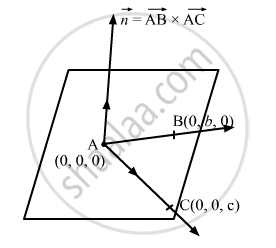
Find the vector equation of the plane passing through points A (a, 0, 0), B (0, b, 0) and C(0, 0, c). Reduce it to normal form. If plane ABC is at a distance p from the origin, prove that \[\frac{1}{p^2} = \frac{1}{a^2} + \frac{1}{b^2} + \frac{1}{c^2} .\]


योग
Advertisements

उत्तर

\[ \text{ The required plane passes through the point } A(a, 0, 0) \text{ whose position vector is }  \vec{a} =a \hat{i} + 0 \hat{j}  + 0 \hat{k}  \text{ and is normal to the vector }  \vec{n}  \text{ given by } \]
\[ \vec{n} = \vec{AB} \times \vec{AC} . \]
\[ \text{ Clearly, } \vec{AB} = \vec{OB} - \vec{OA} = \left( 0 \hat{i} + b \hat{j} + 0 \hat{k}  \right) - \left( a \hat{i}  + 0 \hat{j}  + 0 \hat{k} \right) = - a \hat{i} + b \hat{j}  + 0 \hat{k}  \]
\[ \vec{AC} = \vec{OC} - \vec{OA} = \left( 0 \hat{i}  + 0 \hat{j}  + c \hat{k}  \right) - \left( a \hat{i}  + 0 \hat{j}  + 0 \hat{k}  \right) = - a \hat{i}  + 0 \hat{j}  + c \hat{k}  \]
\[ \vec{n} = \vec{AB} \times \vec{AC} = \begin{vmatrix}\hat{i}  & \hat{j}  & \hat{k}  \\ - a & b & 0 \\ - a & 0 & c\end{vmatrix} =\text{bc }   \hat{i}  + \text{ ac }\hat{j}  + \text{ab } \hat{k}   \]
\[ \text{ The vector equation of the required plane is } \]
\[ \vec{r} . \vec{n} = \vec{a} . \vec{n} \]
\[ \Rightarrow \vec{r} . \left( \text{ bc }\hat{i}  + \text{ac }  \hat{j}  + \text{ ab }  \hat{k}  \right) = \left( a \hat{i}  + 0  \hat{j}  + 0 \hat{ k} \right) . \left( \text{ bc }\hat{i}  +\text{ ac }\hat{j}  +\text{ ab }\hat{k}  \right)\]
\[ \Rightarrow \vec{r} . \left( \text{bc } \hat{i} + \text{ac }\hat{j} + \text{ab }\hat{k}  \right) = abc + 0 + 0\]
\[ \Rightarrow \vec{r} . \left( bc \hat{i} + ac \hat{j}  + ab \hat{k}  \right) = abc . . . \left( 1 \right)\]
\[\text{ Now } ,\left| \vec{n} \right|=\sqrt{\left( bc \right)^2 + \left( ac \right)^2 + \left( ab \right)^2}=\sqrt{b^2 c^2 + a^2 c^2 + a^2 b^2}\]
\[ \text{ For reducing (1) to normal form, we need to divide both sides of (1) by } \sqrt{b^2 c^2 + a^2 c^2 + a^2 b^2}. \text{ Then, we get } \]
\[ \vec{r} . \left( \frac{bc \hat{i}  + ac \hat{j}  + ab \hat{k} }{\sqrt{b^2 c^2 + a^2 c^2 + a^2 b^2}} \right) = \frac{abc}{\sqrt{b^2 c^2 + a^2 c^2 + a^2 b^2}}, \text{ which is the normal form of plane } (1).\]
\[ \text{ So, the distance of plane (1) from the origin,} \]
\[p = \frac{abc}{\sqrt{b^2 c^2 + a^2 c^2 + a^2 b^2}}, \]
\[ \Rightarrow \frac{1}{p} = \frac{\sqrt{b^2 c^2 + a^2 c^2 + a^2 b^2}}{abc}\]
\[ \Rightarrow \frac{1}{p^2} = \frac{b^2 c^2 + a^2 c^2 + a^2 b^2}{a^2 b^2 c^2}\]
\[ \Rightarrow \frac{1}{p^2} = \frac{1}{a^2} + \frac{1}{b^2} + \frac{1}{c^2}\]
\[\]


shaalaa.com
  क्या इस प्रश्न या उत्तर में कोई त्रुटि है?
अध्याय 29: The Plane - Exercise 29.05 [पृष्ठ २३]

APPEARS IN

आरडी शर्मा Mathematics [English] Class 12
अध्याय 29 The Plane
Exercise 29.05 | Q 3 | पृष्ठ २३

वीडियो ट्यूटोरियलVIEW ALL [1]

संबंधित प्रश्न

Find the vector equation of a plane which is at a distance of 7 units from the origin and normal to the vector.`3hati + 5hatj - 6hatk`


Find the equation of the plane passing through (abc) and parallel to the plane `vecr.(hati + hatj + hatk) = 2`


Find the equation of the plane passing through the point (−1, 3, 2) and perpendicular to each of the planes x + 2+ 3z = 5 and 3x + 3z = 0.


If the points (1, 1, p) and (−3, 0, 1) be equidistant from the plane `vecr.(3hati + 4hatj - 12hatk)+ 13 = 0`, then find the value of p.


Find the vector equation of the line passing through the point (1, 2, − 4) and perpendicular to the two lines: 

`(x -8)/3 = (y+19)/(-16) = (z - 10)/7 and (x - 15)/3 = (y - 29)/8 = (z- 5)/(-5)`


Find the Cartesian form of the equation of a plane whose vector equation is 

  \[\vec{r} \cdot \left( - \hat{i} + \hat{j}  + 2 \hat{k} \right) = 9\]


Find the vector equations of the coordinate planes.


Find the vector equation of each one of following planes. 

x + y = 3


Show that the normals to the following pairs of planes are perpendicular to each other. 

x − y + z − 2 = 0 and 3x + 2y − z + 4 = 0 


Show that the normals to the following pairs of planes are perpendicular to each other.

\[\vec{r} \cdot \left( 2 \hat{i}  - \hat{j}  + 3 \hat{k}  \right) = 5 \text{ and }  \vec{r} \cdot \left( 2 \hat{i}  - 2 \hat{j}  - 2 \hat{k}  \right) = 5\]

Find the vector equation of a plane which is at a distance of 5 units from the origin and which is normal to the vector  \[\hat{i}  - \text{2 } \hat{j}  -  \text{2 } \hat{k} .\]


find the equation of the plane passing through the point (1, 2, 1) and perpendicular to the line joining the points (1, 4, 2) and (2, 3, 5). Find also the perpendicular distance of the origin from this plane


Find the vector equation of the plane passing through the points P (2, 5, −3), Q (−2, −3, 5) and R (5, 3, −3).


Determine the value of λ for which the following planes are perpendicular to each other. 

 3x − 6y − 2z = 7 and 2x + y − λz = 5


Find the vector equation of the plane through the points (2, 1, −1) and (−1, 3, 4) and perpendicular to the plane x − 2y + 4z = 10 


Find the vector equation of the line through the origin which is perpendicular to the plane  \[\vec{r} \cdot \left( \hat{i} + 2 \hat{j}  + 3 \hat{k}  \right) = 3 .\]


Find the coordinates of the point where the line through (5, 1, 6) and (3, 4, 1) crosses the   yz - plane .


Find the equation of a plane which passes through the point (3, 2, 0) and contains the line  \[\frac{x - 3}{1} = \frac{y - 6}{5} = \frac{z - 4}{4}\] .


Find the image of the point (0, 0, 0) in the plane 3x + 4y − 6z + 1 = 0.


Find the image of the point with position vector \[3 \hat{i} + \hat{j}  + 2 \hat{k} \]  in the plane  \[\vec{r} \cdot \left( 2 \hat{i} - \hat{j}  + \hat{k}  \right) = 4 .\]  Also, find the position vectors of the foot of the perpendicular and the equation of the perpendicular line through \[3 \hat{i}  + \hat{j}  + 2 \hat{k} .\]


Find the coordinates of the foot of the perpendicular from the point (2, 3, 7) to the plane 3x − y − z = 7. Also, find the length of the perpendicular.


Find the length and the foot of the perpendicular from the point (1, 1, 2) to the plane \[\vec{r} \cdot \left( \hat{i}  - 2 \hat{j}  + 4 \hat{k}  \right) + 5 = 0 .\]


Find the distance of the point P (–1, –5, –10) from the point of intersection of the line joining the points A (2, –1, 2) and B (5, 3, 4) with the plane x – y + z = 5.


Write the equation of the plane passing through points (a, 0, 0), (0, b, 0) and (0, 0, c).


Write the distance of the plane  \[\vec{r} \cdot \left( 2 \hat{i} - \hat{j} + 2 \hat{k} \right) = 12\] from the origin.


Write the equation of the plane containing the lines \[\vec{r} = \vec{a} + \lambda \vec{b} \text{ and }  \vec{r} = \vec{a} + \mu \vec{c} .\]


The equation of the plane parallel to the lines x − 1 = 2y − 5 = 2z and 3x = 4y − 11 = 3z − 4 and passing through the point (2, 3, 3) is


Find a vector of magnitude 26 units normal to the plane 12x − 3y + 4z = 1.


Find the vector equation of the plane with intercepts 3, –4 and 2 on xy and z-axis respectively.


Find the coordinates of the foot of the perpendicular Q  drawn from P(3, 2, 1) to the plane 2x − y + z + 1 = 0. Also, find the distance PQ and the image of the point P treating this plane as a mirror

The coordinates of the foot of the perpendicular drawn from the point (2, 5, 7) on the x-axis are given by ______.


Prove that the lines x = py + q, z = ry + s and x = p′y + q′, z = r′y + s′ are perpendicular if pp′ + rr′ + 1 = 0.


Find the equation of a plane which bisects perpendicularly the line joining the points A(2, 3, 4) and B(4, 5, 8) at right angles.


Find the equation of the plane through the points (2, 1, –1) and (–1, 3, 4), and perpendicular to the plane x – 2y + 4z = 10.


Show that the points `(hat"i" - hat"j" + 3hat"k")` and `3(hat"i" + hat"j" + hat"k")` are equidistant from the plane `vec"r" * (5hat"i" + 2hat"j" - 7hat"k") + 9` = 0 and lies on opposite side of it.


The point at which the normal to the curve y = `"x" + 1/"x", "x" > 0` is perpendicular to the line 3x – 4y – 7 = 0 is:


A unit vector perpendicular to the plane ABC, where A, B and C are respectively the points (3, –1, 2), (1, –1, –3) and (4, –3, 1), is


Share
Notifications

Englishहिंदीमराठी


      Forgot password?
Use app×