Advertisements
Advertisements
प्रश्न
Find the zero of the polynomial in the following case:
p(x) = cx + d, c ≠ 0, c, d are real numbers.
Advertisements
उत्तर
p(x) = cx + d
p(x) = 0
cx + d = 0
x = `-d/c`
Therefore, for x = `-d/c`, the value of the polynomial is 0.
Hence, x = `-d/c` is a zero of the given polynomial.
APPEARS IN
संबंधित प्रश्न
Find p(0), p(1) and p(2) for the following polynomial:-
p(y) = y2 – y + 1
Verify whether the indicated numbers is zeroes of the polynomials corresponding to them in the following case:
`f ( x) = x^2and x = 0`
Find the zero of the polynomial of the following:
p(x) = ax when a ≠ 0
Verify whether the following are zeros of the polynomial, indicated against them, or not
p(x) = x3 – 1, x = 1
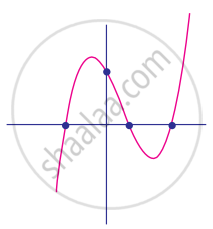
Find the number of zeros of the following polynomial represented by their graph
–3 is a zero of x – 3
0 and 2 are the zeroes of t2 – 2t
–3 is a zero of y2 + y – 6
Find the zeroes of the polynomial in the following:
g(x) = 3 – 6x
If a, b, c are all non-zero and a + b + c = 0, prove that `a^2/(bc) + b^2/(ca) + c^2/(ab) = 3`.
