Advertisements
Advertisements
प्रश्न
Find the point on the curve y2 = 4x, which is nearest to the point (2, 1).
Advertisements
उत्तर १
Let P(x, y) be a point on the curve y2 = 4x
which is nearest to the point A(2, 1).
Let D = AP
∴ D2 = (x – 2)2 + (y – 1)2
Put x = `y^2/4`
∴ D2 = `(y^2/4 - 2)^2 + (y - 1)^2`
Differentiating w.r.t. y,
`2D*(dD)/dy = 2(y^2/4 - 2)((2y)/4) + 2(y - 1)`
∴ `2D (dD)/dy = y(y^2/4 - 2) + 2y - 2`
`2D*(dD)/dy = y^3/4 - 2y + 2y - 2`
∴ `D*(dD)/dy = y^3/8 - 1`
`\implies (dD)/dy = 1/D(y^2/8 - 1)`
For extreme value of D, put
`(dD)/dy` = 0 ...(1)
∴ `1/D(y^3/8 - 1)` = 0
But D > 0
`\implies y^3/8 - 1` = 0
∴ y3 = 8
∴ y = 2
Now `D*(dD)/dy = y^3/8 - 1`
Again differentiating w.r.t. y,
`D(d^2D)/(dy^2) + ((dD)/dy)^2 = 3/8y^2`
But `(dD)/dy` = 0 ...[From (1)]
∴ `D*(d^2D)/(dy^2) = 3/8y^2`
∴ `(d^2D)/(dy^2) = 1/D*3/8y^2`
∴ `((d^2D)/dy^2)_(y = 2) = 1/D*3/8 xx 4`
= `3/(2D) > 0` ...(∵ D > 0)
∴ D is minimum when y = 2
∴ y2 = 4x gives x = 1
∴ The point (1, 2) is the point nearest to (2, 1).
उत्तर २
Suppose the required point on the curve is K(p, q) and the given point is A(2, 1).
∴ q2 = 4p ...(i)
Then, AK = `sqrt((p - 2)^2 + (q - 1)^2`
⇒ S = `sqrt((q^2/4 - 2)^2 + (q - 1)^2` ...[Let S = AK from (i) `p = q^2/4`]
Then, S2 = `(q^2/4 - 2)^2 + (q - 1)^2`
To find nearest point let us suppose S2 = T
Then, T = `(q^2/4 - 2)^2 + (q - 1)^2`
⇒ T' = `2(q^2/4 - 2) xx (2q)/4 + 2(q - 1)`
For critical points T' = 0
⇒ `2(q^2/4 - 2) xx (2q)/4 + 2(q - 1) = 0`
⇒ `(q^2/4 - 2q) + (2q - 2) = 0`
⇒ q3 = 8
⇒ q = 2 ...(ii)
To find the maxima or minima
T" = `(3q^2)/4 - 2 xx 2`
= `(3q^2)/4`
⇒ T" at 2 = `(3 xx 2 xx 2)/4`
= 3 > 0
Therefore, T is least
From (i) q2 = 4p
⇒ 22 = 4p
⇒ p = 1
Therefore, the required point is K(1, 2).
APPEARS IN
संबंधित प्रश्न
Show that the height of the cylinder of maximum volume, that can be inscribed in a sphere of radius R is `(2R)/sqrt3.` Also, find the maximum volume.
An open box is to be made out of a piece of a square card board of sides 18 cms by cutting off equal squares from the comers and turning up the sides. Find the maximum volume of the box.
Find the maximum and minimum value, if any, of the function given by f(x) = |x + 2| − 1.
Find the maximum and minimum value, if any, of the following function given by h(x) = x + 1, x ∈ (−1, 1)
Find the local maxima and local minima, if any, of the following function. Find also the local maximum and the local minimum values, as the case may be:
f(x) = x3 − 6x2 + 9x + 15
Find the local maxima and local minima, if any, of the following function. Find also the local maximum and the local minimum values, as the case may be:
`g(x) = 1/(x^2 + 2)`
Find the absolute maximum value and the absolute minimum value of the following function in the given interval:
`f(x) =x^3, x in [-2,2]`
What is the maximum value of the function sin x + cos x?
A square piece of tin of side 18 cm is to made into a box without a top by cutting a square from each corner and folding up the flaps to form the box. What should be the side of the square to be cut off so that the volume of the box is the maximum possible?
Show that the right circular cylinder of given surface and maximum volume is such that is heights is equal to the diameter of the base.
Prove that the volume of the largest cone that can be inscribed in a sphere of radius R is `8/27` of the volume of the sphere.
A given quantity of metal is to be cast into a half cylinder with a rectangular base and semicircular ends. Show that in order that the total surface area may be minimum the ratio of the length of the cylinder to the diameter of its semi-circular ends is \[\pi : (\pi + 2)\].
Find the point on the straight line 2x+3y = 6, which is closest to the origin.
The perimeter of a triangle is 10 cm. If one of the side is 4 cm. What are the other two sides of the triangle for its maximum area?
The function f(x) = x log x is minimum at x = ______.
If the sum of the lengths of the hypotenuse and a side of a right-angled triangle is given, show that the area of the triangle is maximum when the angle between them is `pi/3`
The function f(x) = 2x3 – 3x2 – 12x + 4, has ______.
The maximum value of `["x"("x" − 1) + 1]^(1/3)`, 0 ≤ x ≤ 1 is:
If y `= "ax - b"/(("x" - 1)("x" - 4))` has a turning point P(2, -1), then find the value of a and b respectively.
Find the maximum profit that a company can make, if the profit function is given by P(x) = 41 + 24x – 18x2.
Find the volume of the largest cylinder that can be inscribed in a sphere of radius r cm.
The function `f(x) = x^3 - 6x^2 + 9x + 25` has
Read the following passage and answer the questions given below.
|
In an elliptical sport field the authority wants to design a rectangular soccer field with the maximum possible area. The sport field is given by the graph of `x^2/a^2 + y^2/b^2` = 1. |
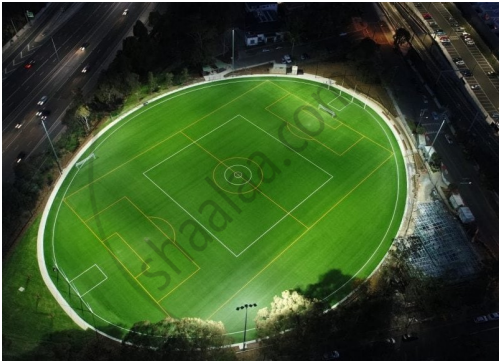
- If the length and the breadth of the rectangular field be 2x and 2y respectively, then find the area function in terms of x.
- Find the critical point of the function.
- Use First derivative Test to find the length 2x and width 2y of the soccer field (in terms of a and b) that maximize its area.
OR
Use Second Derivative Test to find the length 2x and width 2y of the soccer field (in terms of a and b) that maximize its area.
Let x and y be real numbers satisfying the equation x2 – 4x + y2 + 3 = 0. If the maximum and minimum values of x2 + y2 are a and b respectively. Then the numerical value of a – b is ______.
Mrs. Roy designs a window in her son’s study room so that the room gets maximum sunlight. She designs the window in the shape of a rectangle surmounted by an equilateral triangle. If the perimeter of the window is 12 m, find the dimensions of the window that will admit maximum sunlight into the room.

The shortest distance between the line y - x = 1and the curve x = y2 is
If \[\mathrm{A}+\mathrm{B}=\frac{\pi}{2}\] then the maximum value of cosA.cosB is
For a function defined on an interval \[I\], which condition means that \[f\] has a maximum value at \[c\in I\]?
Assume \[f'(c)=0\] and the second derivative exists at \[c\]. Which condition gives a local minimum?
